




Nobody in a field service operation owns the number for how far a van travels in a day. Dispatch owns the appointments, the technician owns the jobs, and the distance between them is an estimate typed into a calendar one appointment at a time.
Route optimization software is bought to fix the result. It can only reorder what the booking screen already committed to. The mileage question is settled earlier, on the screen where the day gets built.
How Much of a Technician’s Day Is Driving
Industry sources put windshield time at 15% to 30% of the workday, with well-run operations described as staying under 20%. Utilization and non-billable time are the two figures most operations already track. Roughly 30% of technician time in a typical operation is non-billable once travel, admin and parts runs are counted.
The 15% to 30% figure is vendor convention, the range the industry argues within.
A single week of completed jobs produces the same figure for the business doing the counting.
The drive legs on those jobs, divided by paid hours, give the share directly. At 30%, a technician is giving close to a day and a half a week to the road. The calculation costs an hour of somebody’s time.
Where the Extra Miles Get Created
Every travel estimate in a schedule is made against a single preceding job. The miles come out of that mechanism. Experienced dispatchers add 15 to 30 minutes of buffer between appointments. A widely used rule adds a 20% margin for local traffic on top of that. Both practices pad the single leg the estimate was made against, leaving the mechanism in place.
Somebody looks at the job being booked and the one before it, decides the drive is about 25 minutes, then books accordingly. Nothing in that exchange refers to the fifth job or the sixth, so the total travel on the day is never a quantity anyone examines before the van leaves.
At the small and mid-size end of the market the buffer is still a person guessing. One scheduling platform’s public idea board lists a request for appointment buffers based on driving distance, on the reasoning that existing schedulers do not serve home-services businesses still booking around drive time by hand. Field service route optimization run at the end of that process can only reorder what the booking screen already committed to. Days built this way look reasonable at every step and still come out crossed.
Sequencing and Zoning the Day
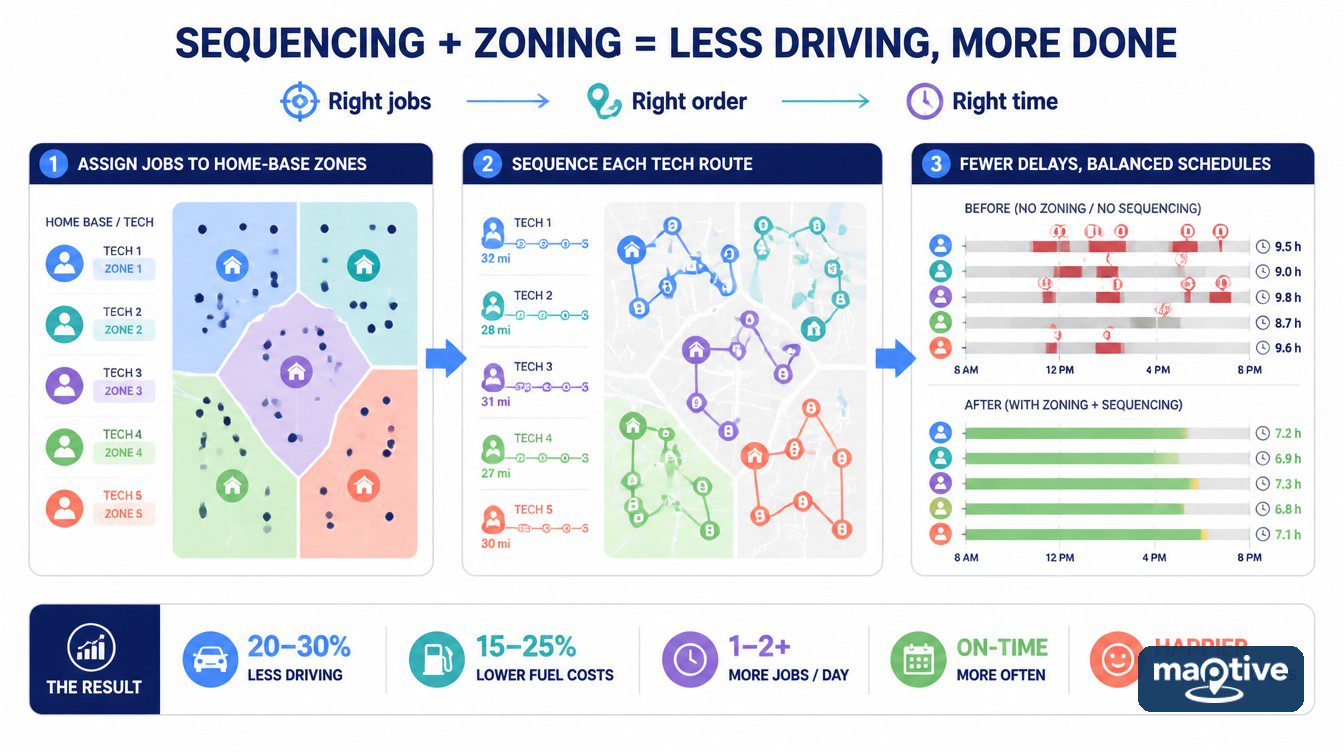
Maptive works against the file a scheduling system exports. Job scheduling, work orders, technician status and real-time dispatch all stay in that system. What crosses over is the mapping, the territory build, the drive-time and distance bands and the route optimization. A route optimizer repairs a sequence once it exists, while a drive-time map changes what the person at the booking screen knows about distance before there is a sequence at all.
Sequencing a Day of Up to 73 Stops
A single route covers up to 73 locations, more stops than a van gets through in a day of short jobs. Get Directions builds the day in the order the stops went in, and then Optimize Route reorders everything between the first stop and the last, both of which stay put. The shop is still the shop at both ends of the technician’s day. A booked morning window survives too, because any stop can be dragged back into position with the stacked handles once the sequence has run.
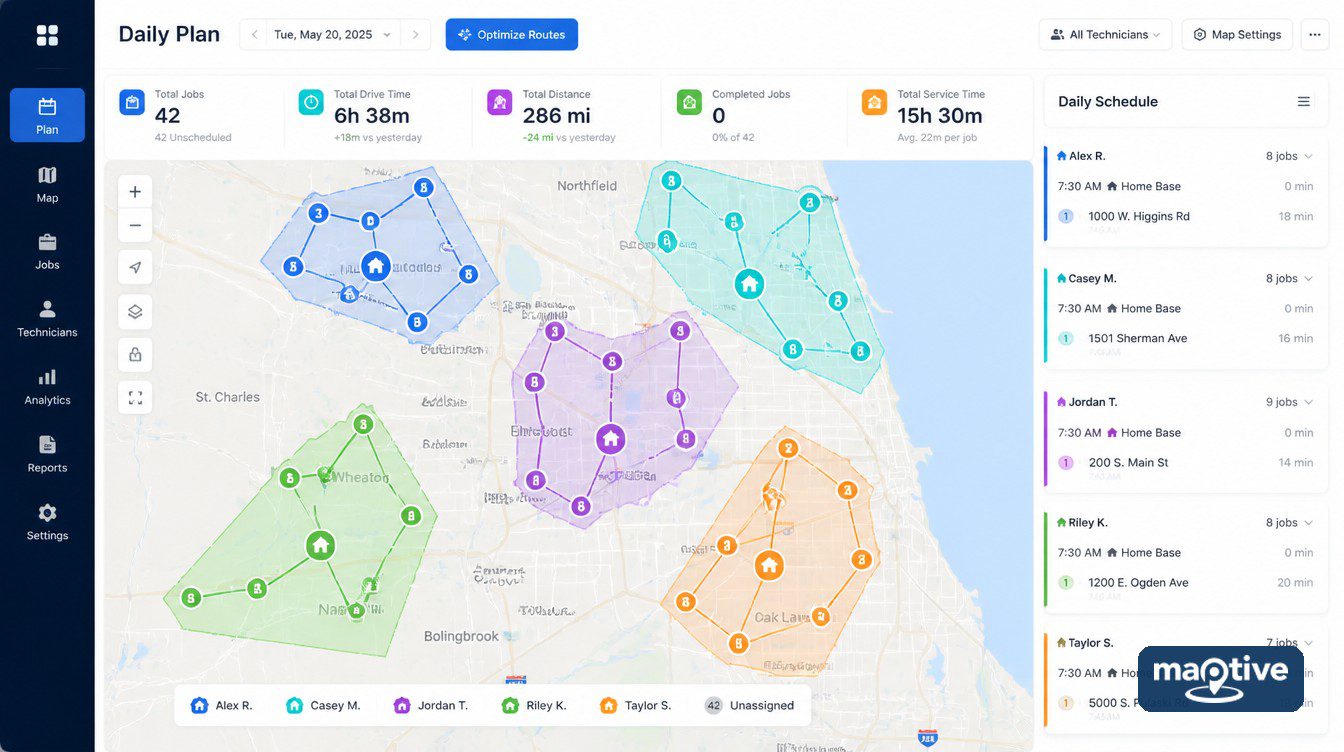
Several technicians’ days can appear on one map at the same time, each route named and colored from its settings icon. Dispatchers argue most often about the two zones that share a boundary, and both days are on screen together for that conversation. What the booked order cost in miles is then a figure on the screen rather than a claim a dispatcher has to defend.
Drive Time Polygons and What They Leave Out
A drive time polygon earns its place at the point it returns a count. The Drive Time Polygon Tool reports how many booked jobs fall within 20 minutes of a given address, and Customize Metrics adds whatever aggregates the operation runs its board from.
Drive time here assumes perfect driving conditions. It takes no account of current or historical traffic, so a 20-minute polygon drawn on a Tuesday morning covers more ground than a technician has at five o’clock. The limitation applies wherever the polygon is used to justify a schedule. As planning geometry it still describes the drive far more accurately than a circle, because a radius treats every direction as equally reachable and no road network behaves that way.
Building Service Zones Around Technician Home Bases
Centering a zone on a technician’s home address changes what the boundary is for, since the first leg and the last leg of the day both start from a driveway rather than from a sales boundary somebody inherited. The Auto Territory Builder will take a separate map of staff home locations and center each area on the person who works it. The builder can be set to balance on the columns the operation runs its board from. Existing territories can serve as the starting point, so a rebalance adjusts the map without replacing it. Field service route optimization then runs against zones that match where the day begins.
A zone map changes nothing until the people booking against it can see the boundaries. A team share hands the finished map to a named colleague with edit or view-only rights, on licenses bought together, and only one of those people can edit at any moment. Give the zone map a single named owner for that reason. A shared or embedded link covers the dispatcher and the scheduler who have to read the zones at booking time, and either version opens on a phone.
Why One Late Job Costs the Whole Afternoon
A morning runs to plan until one job overruns by 40 minutes on a part that turned out to be wrong, and everything after it moves. Every later customer waits. The office takes the calls, at a staff cost nobody counted in the schedule. The technician, aware of the queue, starts working faster than the job deserves, and callbacks come out of that rushed afternoon. The last visit of the day gets the quickest work from someone who has been behind since eleven.
A two-hour arrival window absorbs a normal overrun without starting a cascade. It persists for that reason despite looking imprecise to a customer who asked for a time.
Some operations narrow progressively, booking a half-day window and tightening to two hours 24 to 48 hours out, once the day has taken its final form.
Does Drive Time Make Technicians Quit
Data published from one large field-service software customer base found that technicians driving more than 50 minutes on more than 20% of their jobs were 27% more likely to leave, with excessive drive time appearing alongside overbooking, underbooking and weekend work as leading churn factors. The effect described is a threshold rather than a gradient. Below that 50-minute line the driving is a nuisance, and above it people start looking.
How much the driving costs the person doing it depends on pay structure. A technician on commission or flat rate absorbs an hour of windshield time as an hour with nothing billable attached to it. Unpaid travel time from a job appears on trade forums as a grievance. How that time is treated varies by state and by pay structure, and it is a question for the employer and its counsel. The same hours also show up against field service benchmark data, where the target band is 65% to 80% and travel is one of the standing reasons an operation falls short of it.
Zone Dispatch and Dynamic Dispatch
The choice between zone dispatch and dynamic dispatch is made at the same point in the process as the travel estimate on the booking screen. Route optimization inherits it the way it inherits the booked order.
Zone-based territory assignment gives each technician a geographic area and suits scheduled and recurring visits, because the same person learns the buildings, the access quirks and the customers. It handles same-day emergencies badly. The qualified technician nearest the call frequently falls outside the zone.
Proximity-based dynamic dispatch assigns the nearest qualified person in real time and reroutes when a job cancels or overruns. It answers faster and costs predictability, zone familiarity and stable customer relationships.
Dispatchers name one failure repeatedly, where a late-day emergency reroute pulls a technician out of a tight afternoon cluster and the two short stops that were about to happen fall out of the day.
Practitioner guidance on dispatch comes down on a hybrid, namely zones as the default with a written override rule for emergencies that names who authorizes it and what the override costs the rest of the board. The complaint from dispatchers is about overrides made without that visibility.
Proximity Against Skill on a Dispatch Board
Sending the nearest technician produces a return trip whenever that person lacks the certification, the training or the part the job needed, and the second visit costs far more than the extra distance it was meant to save. Across 157 service organizations measured in a 2025 field service benchmark, the median first-time fix rate was 75%, with the top quintile at 86% and the bottom at 53%. A failed first visit in that data added two more visits on average. Resolution took 14 days longer.
The driving on the other side of that comparison is cheap. Service-provider fleets recorded a median cost per mile of $0.24 in 2025, so as a worked illustration an extra 30 miles on a van costs a little over $7 in vehicle terms. One avoided revisit pays for a great deal of extra driving. The larger cost of those 30 miles is the hour of paid technician time and the fourth job that did not fit.
Skill-based routing therefore pays better than proximity on any job where the parts or the certification are in question, because truck roll costs are $200 to $500 depending on trade and geography, and considerably more once indirect costs are counted. On planned maintenance, where both are known in advance, proximity is the better rule. A dispatch policy that names which rule applies to which job type answers the question once. Without that line, the answer gets made at four o’clock by whoever is holding the board. A written dispatch policy and the travel estimate typed at booking are the two settings that decide how far a technician drives.
Frequently Asked Questions
In Maptive, a single route can include up to 73 locations and the optimization runs across all of them. A route can also be one set of directions to a single location.
It does not. Only the order between the two endpoints changes, which keeps a van leaving from the shop in the morning and returning to it at night. Any individual stop can then be dragged back to a fixed position afterward if a customer window requires it.
It is the area reachable from a point within a set travel time, traced along the road network. The outline follows rivers, highways and access points, so it comes out lopsided rather than round.
Not in any form. The calculation runs on perfect driving conditions, with neither live nor historical traffic in it. In practice a morning polygon and an evening polygon come out identical on screen and unequal on the road, so anything drawn to justify a five o’clock commitment should be treated as optimistic.
Distance against time. The circle answers how far, at a uniform rate in all directions. The polygon answers how far in 20 minutes, along the roads that exist. One address 8 miles out on a highway falls inside that band while another 5 miles out on residential streets falls outside it.
Across 157 service organizations measured in 2025 the median was 75%, with the top quintile at 86% and the bottom at 53%. Industrial machinery was 71% and medical devices 69%.
Three to five jobs a day is the common standard, with some trades averaging up to seven depending on job type. The figure moves with drive distance more than with technician speed.
Most field service organizations target 65% to 80%, with some trade-specific sources citing up to 85%. Roughly 30% of technician time is non-billable in a typical operation.
Service-provider fleets recorded a median cost per mile of $0.24 in 2025, with median annual cost of ownership per vehicle of $9,584. Vehicles more than 10 years old cost up to 35% more per mile.
Common practice adds 15 to 30 minutes between appointments, with a further 20% margin on the travel estimate itself for local traffic. Both also pad one leg at a time, so an operation adding buffer everywhere is treating a sequencing problem as a duration problem.
Two hours is the working standard, because it absorbs a normal overrun without moving every later customer back. Some operations book a half-day window first and narrow it to two hours 24 to 48 hours before the visit.