


A canceled visit can leave a sales rep with an open afternoon and no next stop planned. If finding nearby accounts means searching a spreadsheet, the team has a specific reason to look for a Salesforce Maps alternative.
A replacement should help with the work that prompted the search. That might be filling a gap in a rep’s route or dividing accounts when someone joins the team. Bring one of those tasks into a trial with your own data and check how much work it takes to complete.
| Salesforce Maps alternative | Best fit |
| Maptive | Study account data and balance sales territories |
| Badger Maps | Plan routes and log sales visits |
| Geopointe | Use maps within Salesforce |
| Map My Customers | Keep repeat visits on schedule |
| SPOTIO | Assign rep regions and control lead sync |
Salesforce Maps cost and mobile access
Salesforce Maps has a listed US base price of $75 per user per month, billed yearly, as of September 2026. Ten Maps users would cost $9,000 a year for the add-on, with CRM fees on top. Check how many people need to build maps and how others can view them when you compare that cost with another tool. The standalone Maps mobile app retired on August 31, 2026. Reps can continue to use Maps data and plan routes through Maps Mobile in the Salesforce mobile app. Desktop use is unaffected. A team should assess a switch based on its work and costs with this supported mobile option in mind.
1. Maptive: The Best Salesforce Maps Alternative
Territory analysis across business data
Maptive suits a sales team that needs to study where accounts are and change how reps cover them. For territory reviews that draw on several systems, it can plot CRM exports alongside spreadsheet data. An analyst can bring sales totals and account owners into a map, then use branch or rep locations to assess the sales regions.
The automated territory tool can build regions from your data and demographic fields. You choose how many regions to create and give each selected field a weight. For example, sales value can receive more weight than the number of accounts. The tool can respect rep locations or keep previous territories in mind during the build. Constraints apply to the fields chosen for the territory calculation.
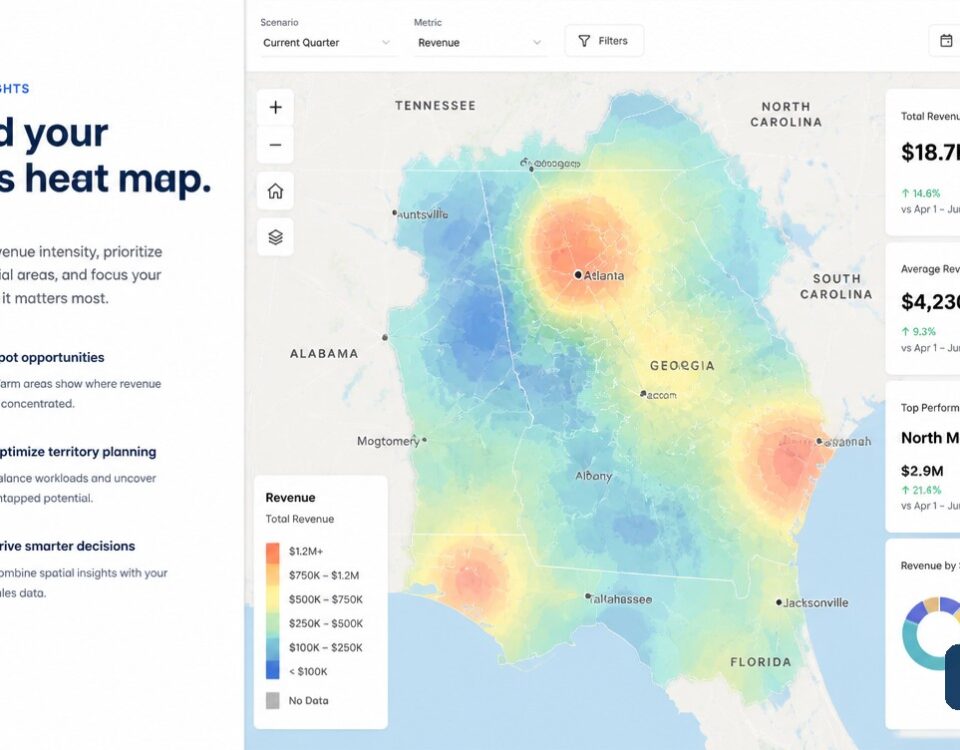
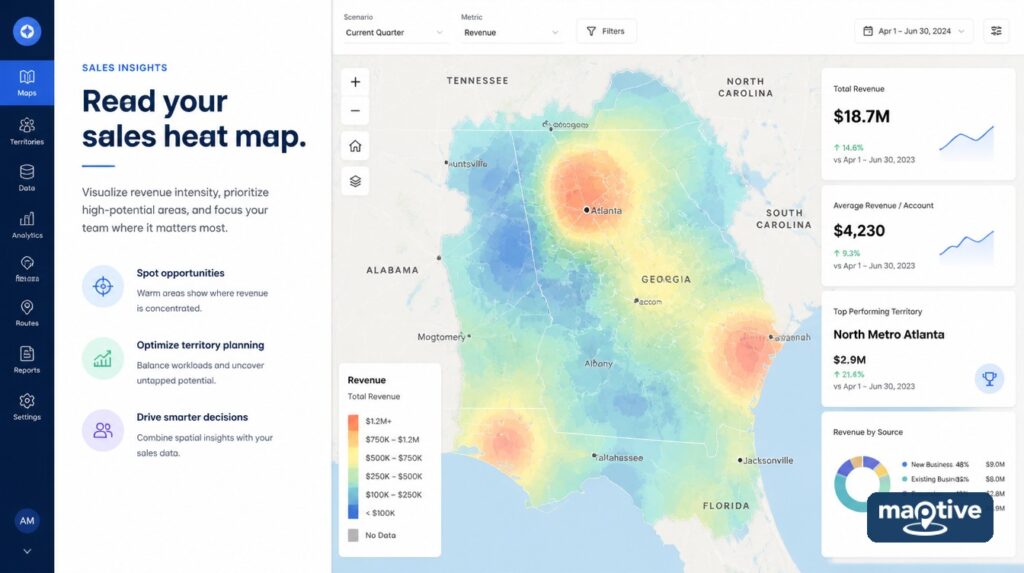
A region with fewer accounts may have more sales value or require more time on the road. Filters let an analyst study a group of accounts, and demographic layers add context about the people in a region. Drive-time tools help assess reach around a branch or rep location. Heat maps show where accounts are clustered or where numeric values are high.
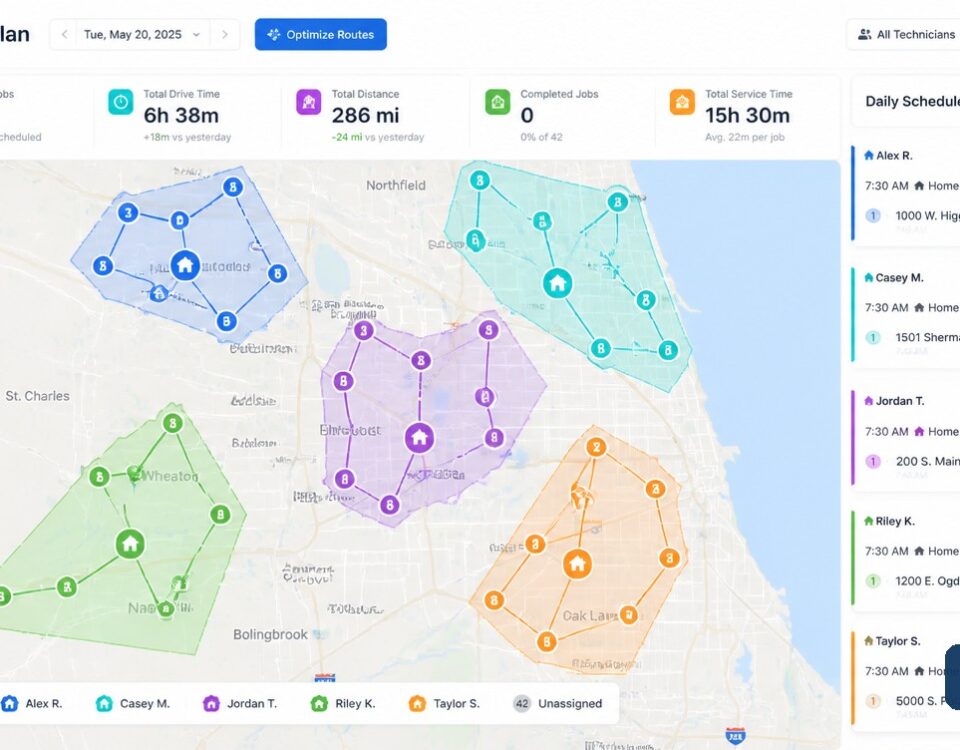
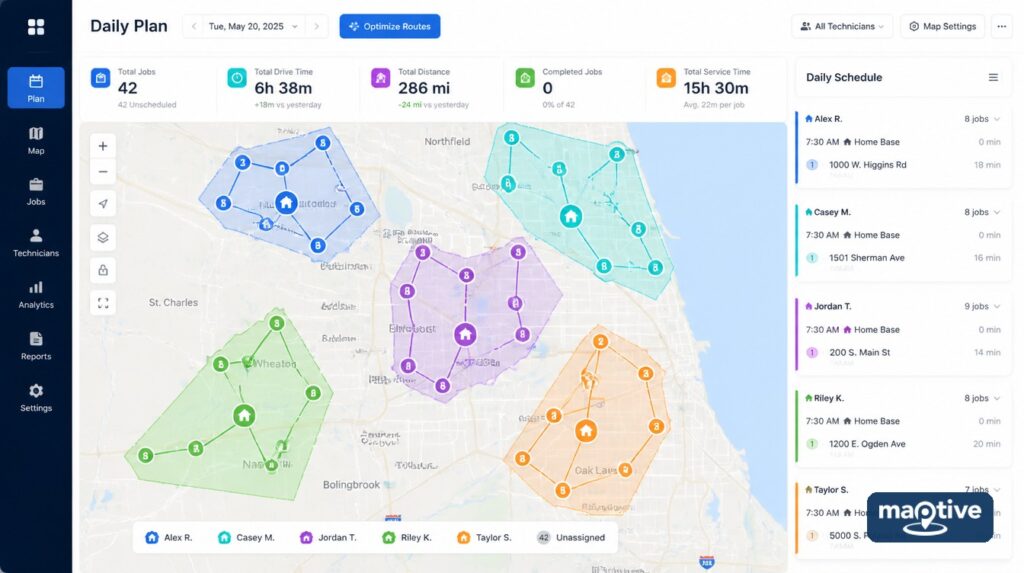
Maptive includes route planning. Its current route tool supports up to 73 stops, with the first and last points fixed during route optimization. You can change the stop order by hand and create several routes on one map. Reps who need to check in at visits should test that workflow in a tool built to record sales activity. Live dispatch also requires a separate system.
Maptive pricing and Salesforce data
Salesforce data can reach Maptive through a spreadsheet import or API feed. An export can include fields such as account owner and sales value. A fresh export can update the data, and an API feed can refresh it on a schedule. Agree who will keep that feed or export up to date.
Before buying, change an account owner in the CRM and check when the map shows it. If the map review leads to new rep assignments, confirm how those changes return to the CRM. Ask for the exact setup needed for your records and fields, including any two-way sync you require.
The Pro plan costs $1,250 a year for one user, or $110 a month with monthly billing, as of September 2026. Team costs $2,500 a year for five users, or $220 a month billed monthly. Both plans include all mapping tools and API access. Enterprise also has API access, while the $250 pass for a 45-day project does not.
Team and Enterprise support shared work between paid users. A 10-day trial lets you test the platform with your own data. You can also share a map with people who do not have a Salesforce seat, using the map owner’s chosen access controls.
2. Badger Maps: Best for Daily Sales Routes
Plan daily sales visits
Badger Maps suits outside sales reps who need a map to plan a day’s visits. They can see accounts and build routes on a phone. Nearby account views and prospect search help a rep add a stop when there is a gap between meetings or a visit ends early.
Test it with the customers due for a visit. A rep may need to call on some accounts every few weeks and others less often. Nearness alone will not show which visit is due. The test route should leave time for the sales meeting at each stop and follow the order in which those accounts need attention.
The Salesforce sync supports field check-ins and notes, with changes exchanged between the two systems. Badger’s team sets up the sync. Confirm that the records and fields used by your sales team are covered, including any custom objects. Write a note on the phone and check its place in the CRM. Then change an account in the CRM and check what the rep sees.
Business includes lead search, with up to 20 new leads visible at a time. This gives reps a way to find prospects near their planned stops. A team that needs a specific source of contact data should test a typical search with the people who will use it. Check the lead detail they need to make the next call.
Badger Maps cost and territory planning
As of September 2026, Business costs $58 per user per month with yearly billing or $69 billed monthly. Enterprise costs $95 per user per month with yearly billing or $109 monthly. Standard two-way CRM sync is part of Business. A free trial can support the first check, with team pilots helping assess use across several reps.
Badger Align is sold separately for territory creation and alignment. It supports weighted data and scenario planning, and the listed price is $20 per territory per month with yearly billing. There is a five-territory minimum. Keep that charge apart from the per-user Maps price when you compare quotes. Reps buying for daily routes can assess Maps on that job, while sales leaders seeking full region planning should ask for Align’s scope and cost.
3. Geopointe: Best for Mapping Inside Salesforce
Geopointe fits teams that want to use maps inside Salesforce. The native app plots CRM accounts and deals directly.
Filters can show high-priority accounts and custom fields. Route tools use distance and account priorities, with time windows to help plan the day. Leaders can study gaps in coverage and differences in rep workloads on the map. The team needs a Salesforce admin to set up the data views and give staff the right access.
You will continue to need Salesforce. Ascent Cloud’s current pricing page asks for a quote and does not publish a seat price. Get the full license scope and setup cost in writing. Territory Planner is a separate product, so ask which planning tools are part of Geopointe and which need another purchase.
Offline use needs a further scope check. Geopointe Go was announced in August 2026 as an offering through a Custom Service engagement. It is a standalone progressive web app that saves maps for a planned region, with supported edits queued until the device reconnects. Teams with poor signal in their sales regions should ask to test it on a rep’s phone. Confirm the service fee and scope, since standard Geopointe licensing should not be assumed to include Go.
4. Map My Customers: Best for Repeat Account Visits
Map My Customers shows scheduled and completed account visits in an agenda and map view. Nearby account suggestions and visit-cadence prompts help reps arrange follow-ups during the week.
Use an account with a set visit interval in the trial. Check how the rep sees it as the next visit comes due and try adding a nearby overdue account to the day. The sales leader should be able to review completed work. A short route can leave too much undone if it misses the accounts that need a call.
Advanced routing supports fixed appointments and saved routes for repeat use. Temporary stops can be added without creating permanent accounts, which helps when a rep needs to include a lunch stop or another stop outside the client list. The feature page describes up to 69 stops and routes planned by time or distance, with traffic considered. Advanced routing is part of Enterprise. Test fixed appointments on the plan you plan to buy.
Industry Leader costs $99 per user per month with yearly payment as of September 2026. Enterprise costs $139. Industry Leader includes two-way CRM sync and manual territory tools, while Enterprise lists smart territory management. Mileage tracking costs extra on Industry Leader and is included in Enterprise. The Salesforce sync page describes a setup fee, so ask for that charge and the supported record types in the quote.
5. SPOTIO: Best for Managing Field Sales Teams
SPOTIO suits sales leaders assigning rep regions and tracking the work done in them. Teams can draw territories or use geographic regions, then assign them to reps or groups. Lead maps and activity dashboards help leaders see who covers each region and what happened on sales visits. It has B2B and B2C plans.
The Salesforce sync supports near-real-time two-way changes, with rules that control which records sync. A team can keep early prospects out of the CRM until they meet its chosen standard. Use a qualified lead and an early-stage prospect to check those rules. Download My Day saves supported route and territory data for offline work, with changes sent after the device reconnects. The stated offline scope is up to 24 hours. Test it where reps expect to lose signal, with the data needed for that day’s visits.
SPOTIO has a five-user minimum and custom quotes. A solo rep or smaller team should check that minimum before a full product test. There is no self-serve free trial. Demos and qualified pilots are offered, and setup charges depend on the team’s needs. Optional tools for engagement or prospect search can add to the bill. Get a quote for the work shown in the pilot, including the CRM sync and offline access your reps need.
Test an alternative with your own accounts
Use real accounts with the fields needed for a region review and the customers due for a visit. Have a sales leader study coverage, then let a rep plan a normal day with a fixed meeting and a change to the stop order. Change an owner or another key field in the CRM and check its place on the map. Log a visit where the tool supports it and inspect the CRM result. Check addresses that failed to plot and the steps needed to fix them. Compare the complete quote with the people who need to create maps or use them in the field. Keep those test results with the quote so the purchase can be assessed against work the team has done.