

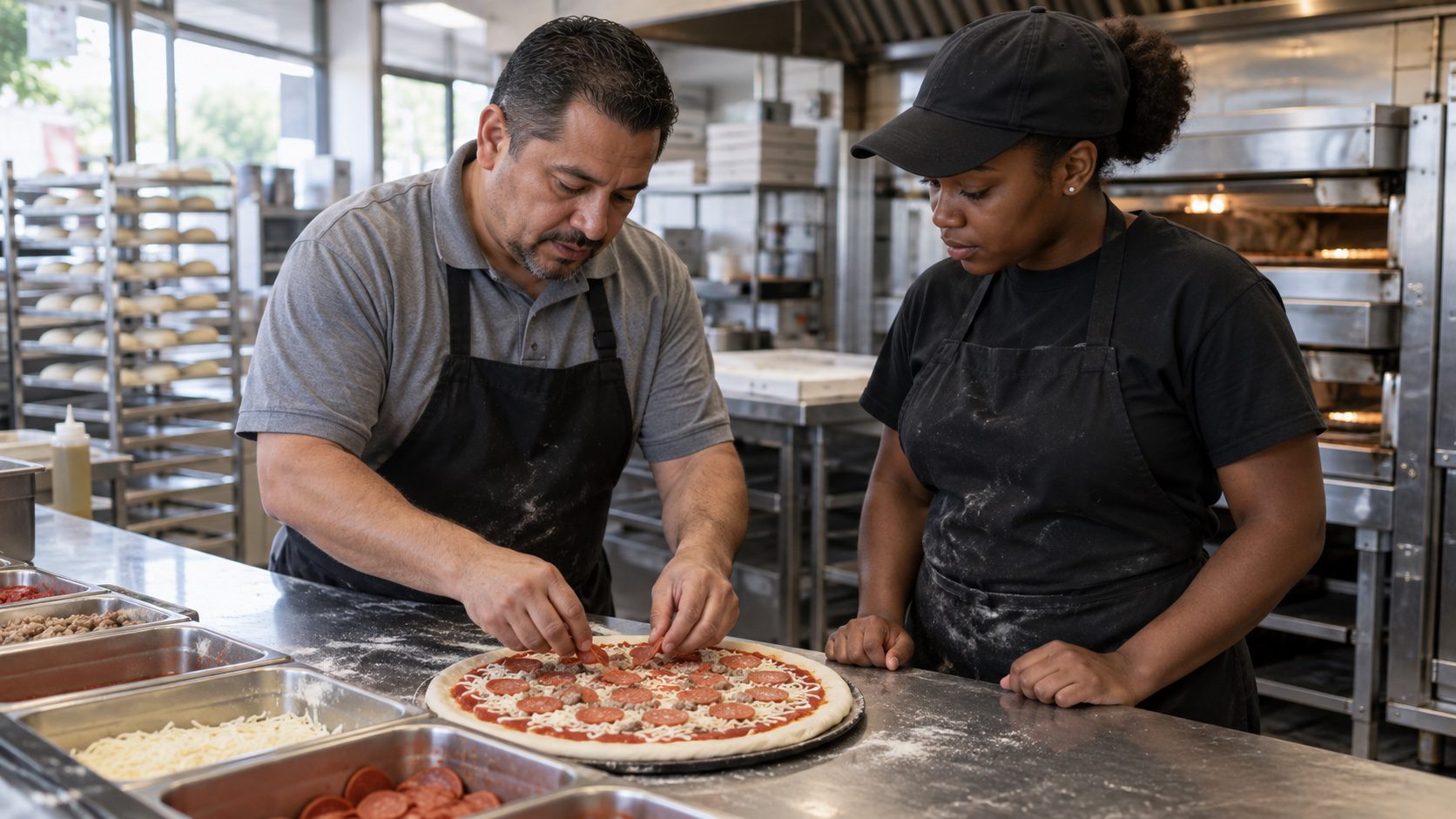
Todd Penegor, the chief executive of Papa Johns, was candid on Wednesday, which is more than most chief executives manage at investor conferences. At the Piper Sandler Growth Frontiers Conference, he described his new "brand standard coaches," pizza experts who grade restaurants and then help fix what they find. "They not only do the restaurant evaluations, but they're spending some quality time in the restaurants, side by side, training, coaching, making sure that we're creating a great experience," he said, according to Restaurant Business. He also put a number on the problem: a sales gap of 400 basis points (four percentage points, for those of us who don't talk like bankers) between the chain's top and bottom operators, and widening. "Any brand is only as good as the lowest common denominator, and what we really need to do is raise the floor," he said.
I don't doubt the coaches will help. Papa Johns suspended its dividend in August partly to fund "franchise financial incentives tied to operational excellence and restaurant image improvements." In effect, shareholders are now paying franchisees to run restaurants the way they already agreed to run them. That is a serious commitment, if a slightly odd one.
My quarrel is with where Penegor thinks the floor gets poured. The spread between a franchise system's best and worst restaurants is mostly set before any coach shows up: when development decides whom to sign, how many units to award, how fast they must open and how far from the owner they will be. Coaching works on whatever development hands it. The people who run operations are graded on that spread, and they should have a vote in the decisions that create it.
What Predicts the Gap Between Franchise Units
The best evidence here comes, fittingly, from pizza. A 2004 Management Science study by Kalnins and Mayer followed Texas pizza restaurants and found that "the units of all multiunit owners, franchised or not, benefited from their owner's local congenital experience, but not from distantly gained experience." In plain terms, an owner who already knew the market did better there, and success somewhere else didn't carry over. The authors drew the conclusion an operations executive should tape to the wall: "These results highlight the continued importance of local experience, even among the most codified and standardized business organizations."
In 2013 Kalnins and Lafontaine looked at more than 1.7 million Texas businesses. The farther one was from its owner's headquarters, the shorter it tended to survive, and hotels that ended up with more distant owners earned less per room. The authors read it as a problem of monitoring and local information, which is a scholarly way of saying the owner wasn't around.
Crumbl grew system sales more than 1,000% after 2020, then watched average unit volumes fall 16% last year, to $1.14 million. Its franchisees did not blame the training. "Franchisees explained to us that the system's early operators were not as strong and didn't run their shops as well," Restaurant Business reported. Those early operators were the ones it signed while it was growing fastest.
Papa Johns owns about 13% of its North American restaurants (456 of 3,439 at the end of June). So the bottom operators Penegor wants to lift are mostly franchisees the company once chose. It is still choosing: its recruiting page now asks for "Established infrastructure for development and expansion." That may be the right bet. It is also an operating decision, and operations isn't making it.
Can Field Coaching Close the Gap?
The strongest case against me is Burger King, and Jonathan Maze of Restaurant Business has made it well. Under its president, Tom Curtis, Burger King went back to basics. In July, Maze reported Technomic data showing 41% of its customers rated their last visit "excellent," up from 35% a year earlier and ahead of McDonald's and Wendy's. No marketing rescues restaurants that "look and operate like garbage," Maze wrote. He is right.
Look at what else Burger King did, though. In 2023 Restaurant Business reported, "The company will only allow the strongest operators, those rated 'A' or 'B,' to expand." Josh Kobza of parent company RBI was more direct: "In an ideal world, I'd like it if they can drive to all their restaurants." That is the Kalnins finding as a management rule. Burger King wanted bankrupt Meridian's 116 restaurants sold in pieces, and by this spring stores were being steered to better franchisees. The back-to-basics effort worked on a portfolio that development had already sorted. Maze himself has noted that franchisors can only "cajole" franchisees through incentives or punishments. The largest incentive a franchisor has is permission to open the next store. Burger King used it.
To be fair to big operators, Curtis also said, "Some of our absolute best operators have 100 or 200 restaurants." The test is whether a given operator suits that many units, at that pace, in that place.
The other serious objection came from the same conference, the same morning. Cava's Brett Schulman said about two-thirds of the chain's 476 restaurants are "exceptional," and set the bar at "Every location. Every shift." Cava owns all of its restaurants. It has no franchisees to blame, and a third of its units still fall short. Papa Johns' own company stores posted worse second-quarter comparable sales than its franchised ones (down 8.9% against 8.2%). Ownership doesn't cure variance, and I concede the point.
But read Cava's fixes. General managers now go into a new market six months before opening instead of three. Delivery isn't switched on when a restaurant opens, and marketing starts later. All three are decisions about how new units open. A chain with no franchisees has concluded that consistency is mostly settled in the pipeline.
What Operations Should Ask Development For
If your CEO comes back from this week wanting brand standard coaches of your own, build them. Then take three requests to development.
First, ask for a vote on expansion rights, tied to the operating grades you already keep. Burger King has already written the rule for you.
Second, ask for a distance and local-knowledge test on every award. An operator's success three states away says little about the market in front of you.
Third, ask that opening schedules follow what an operator can stabilize, not what development can sell. Peter Allen, COO of the multi-brand operator MSI, named the skill: "When you build or acquire a restaurant, one of the things you need to have good talent for, and be strong at, is moving from that first day to being stable." Ask who will do that for each store in a new agreement, and when.
Development will say this slows growth, and it will, a little. You can answer that you are the one who inherits every store they sign, for as long as it stays open, and that you would rather help pick them than spend years coaching them up to the floor.