




Territory imbalance is diagnosable in the data months before quota attainment dispersion makes it undeniable. The leading indicators (win-rate spread, pipeline-coverage variance, activity-to-pipeline divergence, deal-cycle tail length) move first. Attainment moves last.
Most sales leaders wait for the lagging signal because the leading ones require pulling reports nobody owns. By the time year-to-date attainment shows a 30-point gap between the top and the bottom rep, the territory has been structurally broken for two quarters, two AEs have updated their LinkedIn, and the renewal pipeline in the worst territory has been thinning the entire time.
The position of this piece is plain. If you are diagnosing territory imbalance through quota attainment, you are doing forensics on a body that died last quarter. The signals you need are already in the CRM.
The Leading Indicators That Surface First
Four metrics move before attainment moves. Each one sits in the CRM, untracked at the territory level by most teams because nobody owns the cross-rep view. The reason these are leading indicators is structural. Win rates, pipeline coverage, and activity output respond to account-mix changes within the quarter the imbalance forms. Quota attainment requires deals to close, which means it lags by the length of the sales cycle plus the time required for statistical confidence in the dispersion.
Win-Rate Dispersion by Deal Size
A blended company-wide win rate is meaningless for territory diagnosis. Sub-$50K deals close at 25-35%, deals over $1M close at 10-18%, and a rep with a different account mix will show different blended numbers without any underlying skill or coverage difference. The diagnostic comparison happens after segmentation.
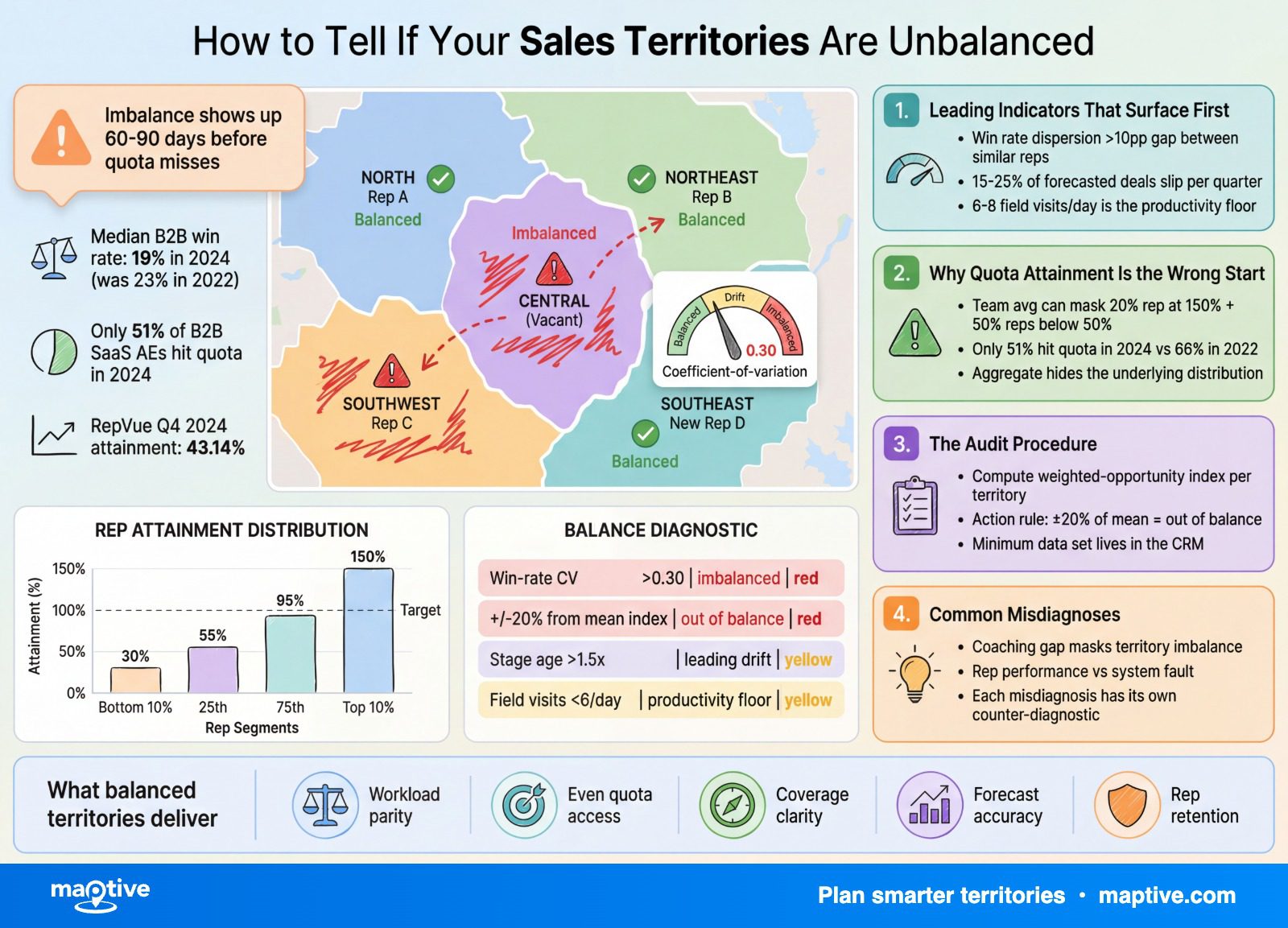
The median B2B win rate sat at 19% in 2024, down from 23% in 2022. That is the floor reps are working against, and it has moved. Inside any sales team, the rep-to-rep variance after segmentation by deal size is the signal. When two reps working comparable account mix show win rates more than 10 percentage points apart, the question is no longer if something is off. The question is what. The rep may be selling against weaker fit accounts, weaker buying intent, or a tighter competitive set. All three are territory variables before they are rep variables.
Pipeline Coverage Ratio Variance
Pipeline coverage is the cleanest leading indicator because it shows the math before any deal closes. The classic 3x-4x benchmark still holds in steady markets, but at a 19% median win rate, raw coverage of 5.3x is needed to break even on quota. The benchmark moved because the conversion moved.
The relevant view is coverage by territory, not by team. New-market territories need 5-7x until conversion rates stabilize. Newer reps with lower win rates may need 5x, veterans can run at 2x. After controlling for tenure and sales motion, if some territories sit at 3x while others sit at 6x, opportunity is not being distributed evenly. The rep at 3x is not lazy. The rep at 6x is not exceptional. The territory math diverged.
Activity-to-Pipeline Conversion
Activity volume comparable, pipeline output not comparable, equals a density problem. A rep making 50 outbound calls per day into a territory of 200 ICP accounts has fundamentally different conversion economics than a rep making 50 calls into 2,000 ICP accounts. The first rep is calling the same logos repeatedly. The second is working a colder list every day.
Reps spend roughly 30% of their time actively selling. The remaining 70% goes to admin, data entry, internal meetings, and prospecting. That 30% baseline is the comparison floor. Field reps consistently hitting 6-8 visits per day outperform those averaging 3-4, but only when the underlying account density supports the visit rate. If activity is at parity and pipeline is not, the territory math is the cause, not the effort.
Deal-Cycle IQR and P90
Median cycle length hides territory complexity. The right reporting view is median plus P75, P90, and the interquartile range, per rep and per territory. Two reps can show identical 60-day medians while one has a P90 of 90 days and the other has a P90 of 240 days. The second rep is working deals with more stakeholders, longer evaluation processes, harder buying committees, or all three. That long tail is invisible in averages.
Deal slippage compounds the same effect. Industry average is 15-25% of forecasted deals slipping each quarter, and high-performing SaaS teams stay below 10%. When slippage rates diverge sharply across territories, the slippage is usually traceable to deal complexity, not rep discipline.
Why Quota Attainment Is the Wrong Place to Start
Attainment is the metric every leadership review opens with. Comp is tied to it, the board reports against it, and the year-end summary lives or dies by it. The argument here is not that attainment is wrong. The argument is that attainment is structurally too late to be diagnostic.
The 2024 numbers set the context. Only 51% of B2B SaaS account executives hit quota in 2024, down from 66% in 2022, per The Bridge Group’s benchmark covering 172 companies with median $24M revenue. Salesforce’s State of Sales 2024 found 67% of global reps did not expect to hit quota that year, and 84% had missed it the prior year. RepVue’s Q4 2024 Cloud Sales Index recorded average attainment of 43.14%. The healthy band of 70-120% is now where roughly half of all AEs sit.
Inside a sales org, blended attainment of 47-50% is normal. Plans are deliberately designed so most reps land below 100% with accelerators concentrating reward in the top performers. What matters is the shape of the distribution. The most overlooked imbalance signal is a bimodal attainment curve. A team where 20% of reps hit 150%+ and 50% sit below 50% averages to roughly 80%, which reads acceptable on a slide. The underlying distribution is broken into two populations, and bimodal distributions in attainment almost always trace back to unequal territory design or to quota plans that ignore territory potential.
The lag time also matters. Attainment dispersion requires deals to close. Statistical confidence in the spread requires multiple deals per rep across the period. That timeline runs 1-2 quarters minimum in mid-market motions and longer in enterprise. The leading indicators above show movement inside the quarter the imbalance forms.
The Audit Procedure
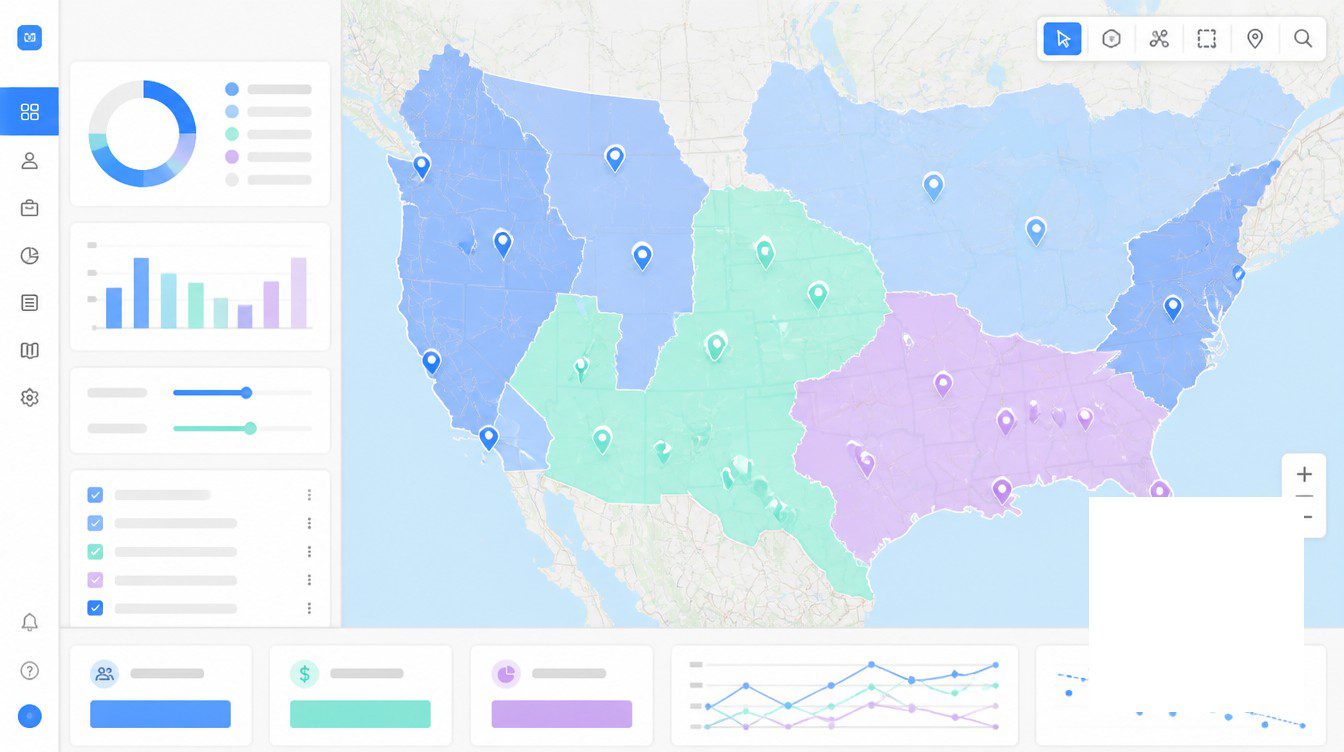
A territory balance audit is a data pull, not a consulting engagement. The minimum data set lives in the CRM. The threshold for action is mathematical, not subjective.
Minimum data pulls:
Account locations and revenue per territory
Open pipeline by territory and stage
Rep activity volume (calls, emails, meetings, visits)
Historical win rates per rep, segmented by deal size
Quota attainment by rep over the last 4-6 quarters
The single-number balance check is the coefficient of variation across territories. CV equals standard deviation divided by the average. Below 15%, the territory split is healthy. Between 15 and 25%, rebalancing is worth doing. Above 25%, the territory model needs a full redesign. The same calculation can be run on opportunity, revenue, workload hours, and travel time separately to produce a multi-dimensional view.
A territory balance index combines these variables into a single workload index per territory. Weighting depends on sales job design and process complexity. Field motions weight travel time more heavily, inside motions weight workload hours and signal density. Once the index is computed, the action rule is the +/-20% threshold. Any territory more than 20% above or below the average index value is out of balance and is a candidate for redesign.
What “balanced” means depends on what is being equalized. Geographic balance equalizes land area, which is rarely useful alone. Account-count balance equalizes the number of accounts per rep, which ignores account quality. Workload balance equalizes the hours required to serve accounts at target call frequency. Opportunity balance equalizes TAM or pipeline potential. Revenue balance equalizes current book value. Modern practice balances opportunity and workload together. Account count alone has not been a defensible balancing variable in over a decade. Mapping software like Maptive supports the geographic, account-density, and travel-time inputs that feed the index. The math itself is independent of the tool.
Common Misdiagnoses
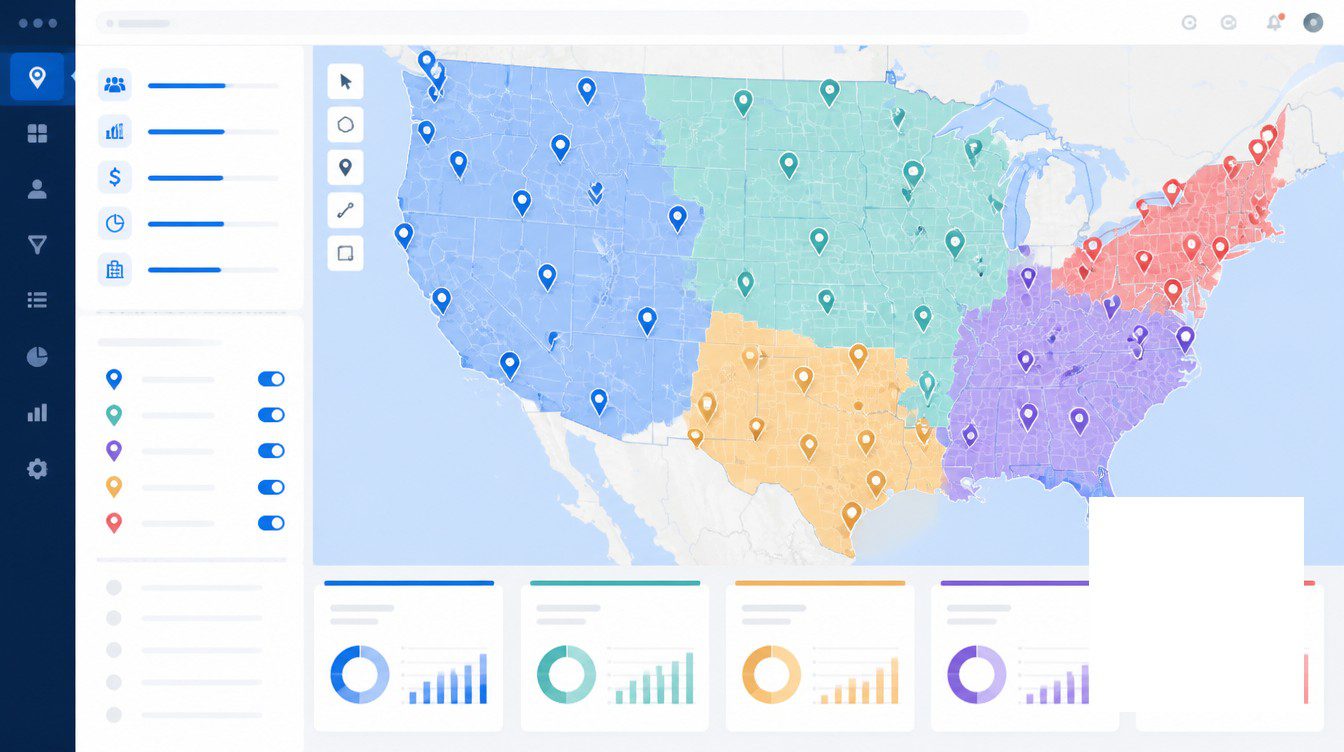
The four most common explanations for underperformance all share a property. They let leadership avoid the territory-design conversation. Each has a diagnostic that points the other way.
Blaming the Rep When the Territory Is the Cause
The single diagnostic question before launching a performance improvement plan is this. If this rep had the best rep’s territory, would the outcome be different? The Alexander Group frames the same test in their research, and the answer is almost always yes when one rep sits at 200% of quota on a dense metro book and a peer struggles at 60% on a rural stretch with fewer prospects per square mile. Putting a PIP on the 60% rep is ineffective and demoralizing, and the rep will leave inside two quarters regardless of intervention. The replacement will hit similar numbers in the same territory, because the territory is the variable.
Blaming the Product When Coverage Is Uneven
When win rates drop across the board, leaders blame product-market fit or competitive pressure. The diagnostic check is the territory-level breakdown. If win rates dipped in three territories and held in five, the product is fine. The three territories are running uneven coverage, hitting saturation on dense accounts, or losing density advantage to a new competitor in those zones. Product roadmap is the wrong response. Coverage redesign is the right one.
Blaming the Market When Only Some Territories Show It
“The market is soft” is the explanation reps and leaders both reach for when pipeline thins. The diagnostic is the pipeline-coverage ratio across territories. If coverage is falling in every territory at the same rate, the market is soft. If one territory is hemorrhaging coverage while another holds steady, the imbalance is internal. The market is the same market for both reps.
Blaming Compensation When Earning Opportunity Is Unequal
Reps complain about quota or OTE, leadership reviews comp plans, and the underlying problem goes untouched. The deeper issue is that unequal territories produce unequal earning potential. The OTE is technically equal across the team. The achievability of that OTE is not. Rep turnover concentrates in the same territories regardless of who fills them, because the same math defeats every rep assigned. Track turnover by territory over rolling 12-month windows. When the same territory loses three reps in two years, the territory is the variable, not the people. Replacement cost runs $114,957 to $150,000 per quota-carrying B2B rep once recruiting, onboarding, training, and lost sales during the open period are loaded in, and the average replacement cycle runs 6.2 months from departure to a fully ramped successor. That cost compounds quarter over quarter as long as the territory math stays broken.
Frequently Asked Questions
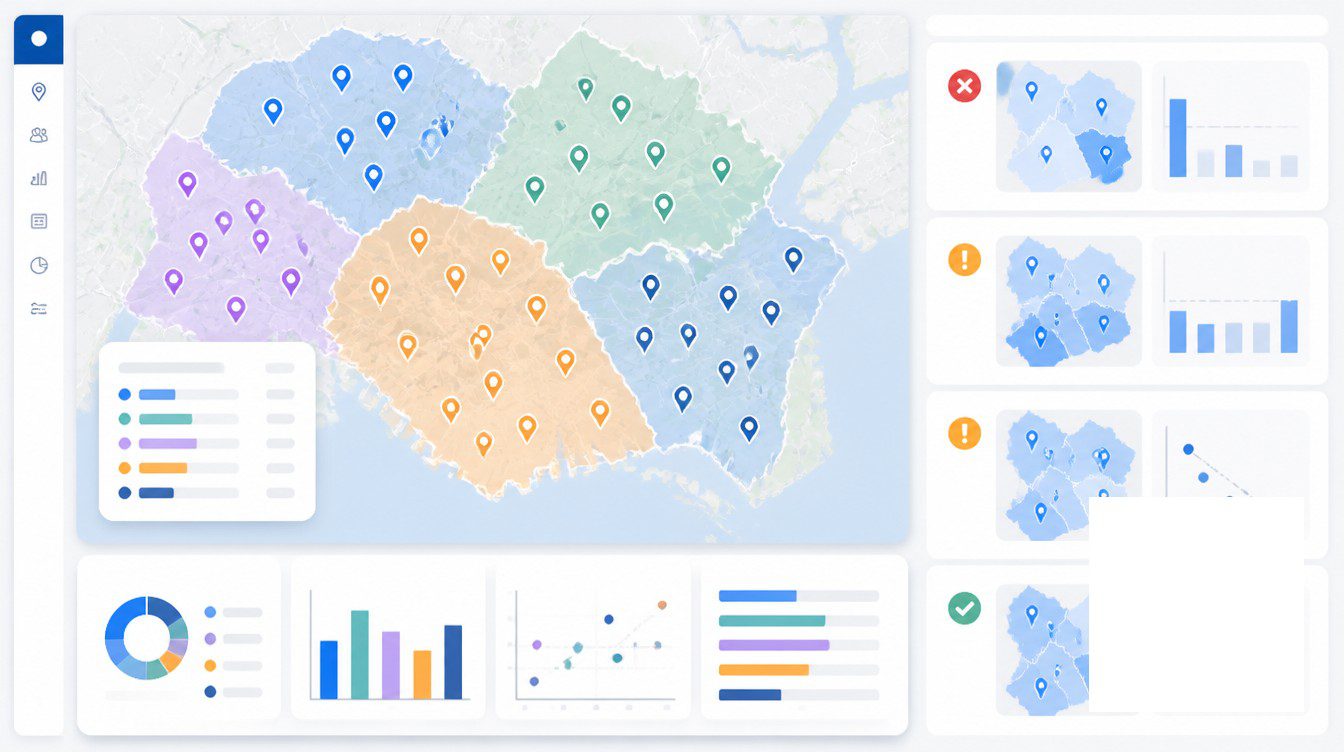
What are the signs that sales territories are unbalanced?
The clearest signs are wide quota attainment dispersion (one rep at 200% while a peer struggles to hit 60%), win-rate swings of more than 10 percentage points between similar territories, pipeline coverage ratios below 3x in some territories while others sit at 6x, persistent rep turnover in the same territories regardless of who fills them, and activity-volume parity that does not produce pipeline parity. None of these are conclusive alone. Two or three appearing together strongly indicate imbalance.
How do I know if it’s my rep or my territory causing underperformance?
Ask one question. If this rep had the best rep’s territory, would the outcome be different? If yes, the territory is the cause. Poor territory design can make a capable seller look like a poor performer. Compare the rep’s activity volume, conversion rates, and average deal size against peers on equivalent territories before launching any performance improvement plan.
What is win rate dispersion?
Win rate dispersion is the spread between the highest and lowest win rates across reps or territories after controlling for deal size and sales motion. A blended company-wide win rate hides the spread. Best practice is to segment by deal size first, then compare rep-to-rep variance within each segment. When variance exceeds 10 percentage points among reps working comparable territories, suspect either coaching gaps or territory imbalance.
What is a healthy quota attainment rate?
The healthy band is 70-120%, with 70-100% considered well-calibrated and 100-120% indicating strong performance with quotas still meaningful. Company-wide averages of 47-50% are common because plans are designed so most reps land below 100%. In 2024, only 51% of SaaS account executives hit quota, down from 66% in 2022, and RepVue’s Q4 2024 average attainment was 43.14%.
How do you measure if sales territories are fair?
The standard measure is the coefficient of variation, calculated as standard deviation across territories divided by the average. Below 15%, the split is healthy. Between 15 and 25%, rebalancing is worth doing. Above 25%, a full redesign is needed. The measure can be applied to opportunity, revenue, workload, and travel time separately.
What is a territory balance index?
A territory balance index combines opportunity, revenue, workload, and travel time into a single score per territory. Each variable is weighted based on sales job design and process complexity, then scored across territories. Territories falling outside plus or minus 20% of the average index score are considered out of balance and are candidates for rebalancing.
How much revenue do unbalanced territories cost?
Alexander Group research shows territory imbalance can reduce sales capacity by 15-25%. Zoltners and Sinha at ZS Associates put revenue left on the table by poorly aligned territories at 2-7% of annual sales. Companies that thoughtfully design territories realize a 10-20% increase in sales productivity. Forrester research finds organizations overspend on low-potential customers while underspending on high-potential customers when territories are out of balance.
What pipeline coverage ratio should each territory have?
The classic benchmark is 3x-4x quota in open pipeline. New market territories need 5-7x until conversion rates are established. Newer reps with lower win rates may need 5x while veterans can operate at 2x. At a 19% median win rate, raw coverage of 5.3x is needed to break even on quota. Wide variance in coverage ratio across territories, after controlling for tenure and motion, signals uneven opportunity distribution.
Why does sales rep turnover concentrate in certain territories?
When the same territories lose reps regardless of who is assigned, the territory itself is the variable. Common causes are workload that exceeds capacity, opportunity scarcity that prevents reps from earning OTE, or quota math misaligned with territory potential. Roughly 62% of salespeople report burnout from lack of focused-work time, and 67% of sales workers report working more hours than contracted. Track turnover by territory over rolling 12-month periods to surface the pattern.
What does the Pareto principle have to do with territory imbalance?
Roughly 80% of revenue comes from 20% of clients, but the ratio can be 90:10 or 70:30 in individual territories. When revenue concentration varies sharply across territories, the reps have different risk profiles. Losing a single account in a concentrated territory drops the rep below quota regardless of skill. Compare top-5-account concentration percentage across territories as part of any balance audit.
What data do I need to audit my sales territories?
The minimum data set is account locations and revenue, pipeline by territory, rep activity volume, historical win rates, and quota attainment by rep. Add total addressable market data, signal density indicators, customer footprint, and rep capacity hours for a complete view. Most of this data lives in the CRM and existing market data subscriptions, so no new spend is required to run an initial audit.
How often should sales territories be reviewed for balance?
High-performing sales organizations review territories at least annually, typically at the start of the fiscal year. Best practice treats territory management as an ongoing discipline rather than a once-a-year exercise. Quarterly reviews of leading indicators (win rate dispersion, pipeline coverage variance, activity-to-pipeline ratios) catch drift before it becomes a year-end quota crisis.