



AI is competent at the math underneath territory design and incompetent at the work that surrounds it. The math is constraint satisfaction across thousands of accounts and dozens of reps under several competing objectives at once. The surrounding work is everything else, including which rep has earned which account through years of contact, what the comp impact of a reassignment will be, who will quit if the lines move the wrong way, and how the new map gets explained to a sales floor that has reasons to distrust it.
That split is the whole article. Buyers who treat AI as the answer to “redesign our territories” are answering one question with a tool built for a different one. Buyers who treat it as the answer to “solve this multi-objective optimization problem in minutes instead of weeks” are using it for what it actually does.
The Math AI Handles Competently
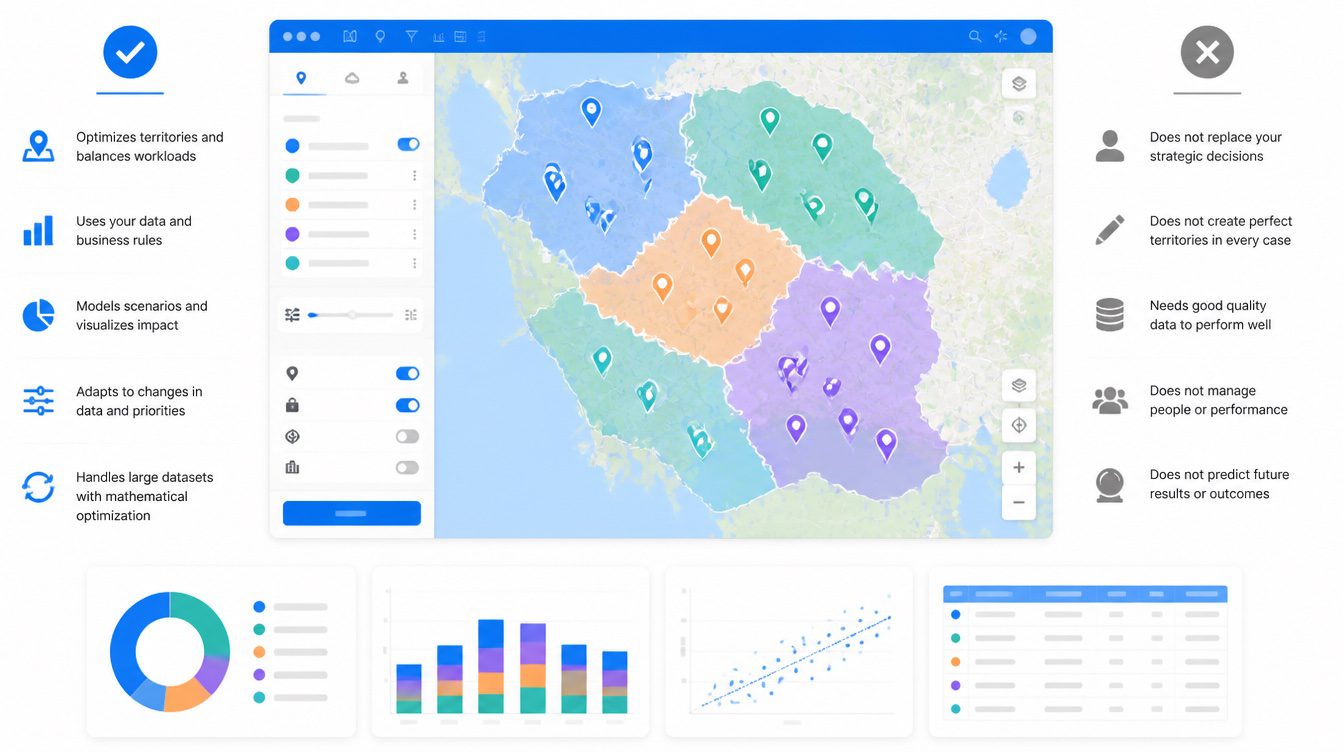
A territory problem with 1,000 accounts, 50 reps, and four competing objectives is past the size where a human finds a good solution with a spreadsheet. Account counts, revenue, drive time, and existing relationships all pull against each other, and trading any one off for another shifts every assignment in the map. Manual approaches at that scale produce defensible-looking results that an optimizer can usually beat by a wide margin.
This is where AI is doing real work. The formal class of problem is multi-objective mixed-integer linear programming, or MOMILP, and modern solvers handle it routinely. A published case showed a multi-objective genetic algorithm cutting the standard deviation of sales across territories in half while increasing total travel distance by only 3%. The tradeoff curve, called a Pareto frontier, is the actual output of a competent territory optimizer. It shows the set of solutions where no objective can improve without another getting worse, and a sales leader picks the point on the curve that fits their priorities.
What changed in 2024 to 2026 is not the algorithm. The algorithm has been around for decades. What changed is the speed and the per-account signal. Compute is cheap enough that scenarios run in minutes inside a planning meeting instead of overnight in a queue. Propensity scoring, built on machine-learning models that ingest hundreds of variables per account, gives the optimizer a per-account likelihood-to-buy score that weights accounts by expected revenue rather than treating them as equal.
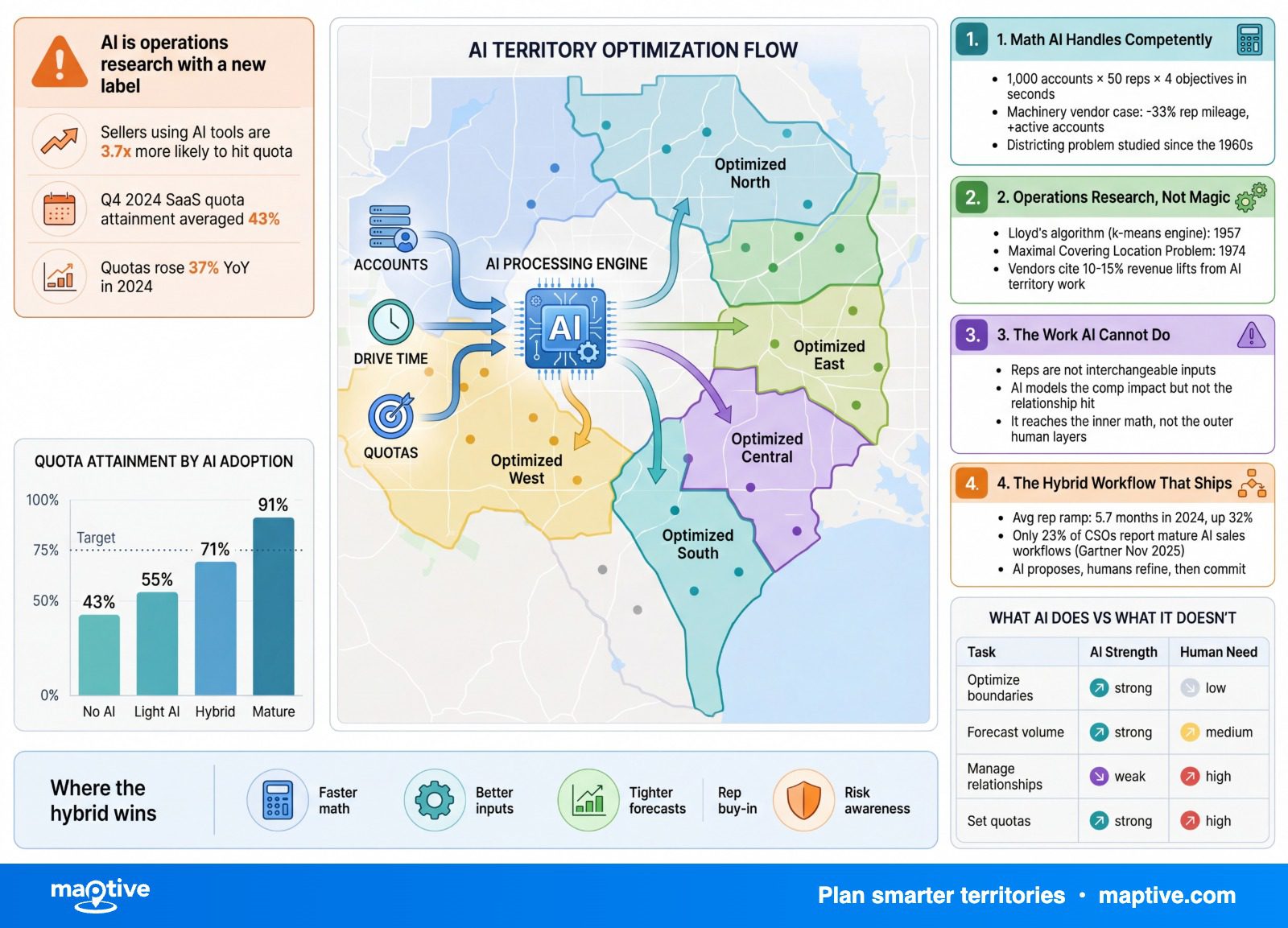
The practical result is a reduction in the prep cost of territory work. A documented machinery-vendor case cut rep mileage by 33% and increased active selling hours per rep by 22% by automating the mapping work and pushing low-potential zones to distributors. Sellers who effectively partner with AI tools are 3.7 times more likely to meet quota than non-users. These are productivity numbers in a specific part of the workflow, not transformation numbers.
Operations Research Wearing an AI Label
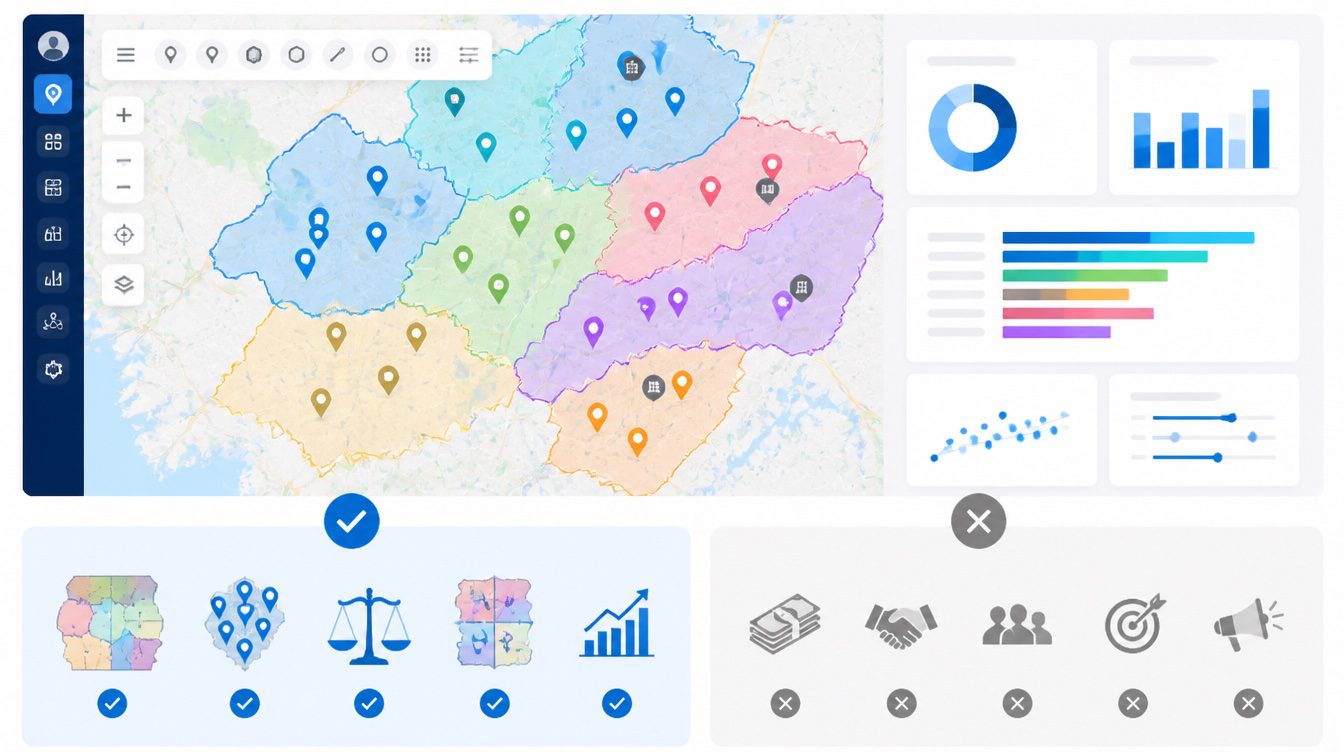
Most of the math marketed as “AI territory optimization” is operations research that predates the current wave of foundation models by 50 to 60 years. Territory design has been studied as an academic problem since the 1960s under the name districting. The p-median problem, which minimizes the weighted sum of distances between demand points and their closest facility, dates to Hakimi in 1964 and still runs inside modern compactness-focused tools. The Maximal Covering Location Problem dates to Church and ReVelle in 1974. Lloyd’s algorithm, the engine inside k-means clustering, is from 1957. When a tool says “click here and we will cluster your accounts into balanced regions,” Lloyd’s algorithm is what runs.
This changes the buyer’s question. The useful one is not “is your tool AI-powered.” Every territory tool sold in 2026 answers yes. The useful question is which optimization algorithm runs under the hood, what is genuinely new about the implementation, and how it differs from an operations-research deployment from ten years ago. If the vendor cannot answer, the math is probably not new.
What is genuinely new sits in three places. Foundation-model propensity scoring brings a richer per-account signal than older gradient-boosted approaches. LLM-based conversational interfaces have become the front door to territory dashboards, with hybrid agent architectures using language models for zero-shot interpretation plus a tool-based runtime for safe query execution. The compute-and-solver combination makes interactive multi-objective scenarios tractable where they once required a batch run. None of these is the optimizer itself. They sit around it.
The ROI conversation deserves the same skepticism. Vendor decks cite revenue lifts of 10% to 15% from AI territory work and ROI ratios as high as 25 to 1 against traditional methods. Analyst-conservative numbers land at 2% to 7%, the range Harvard Business Review reported for territory redesigns long before AI entered the conversation. Across all AI initiatives, roughly 25% deliver expected ROI and only 16% scale enterprise-wide. Any AI revenue claim should be challenged on three points, including the baseline it was measured against, the timeframe it covers, and the segment it applies to. Without those answers, the number is a marketing artifact.
The Work AI Cannot Do
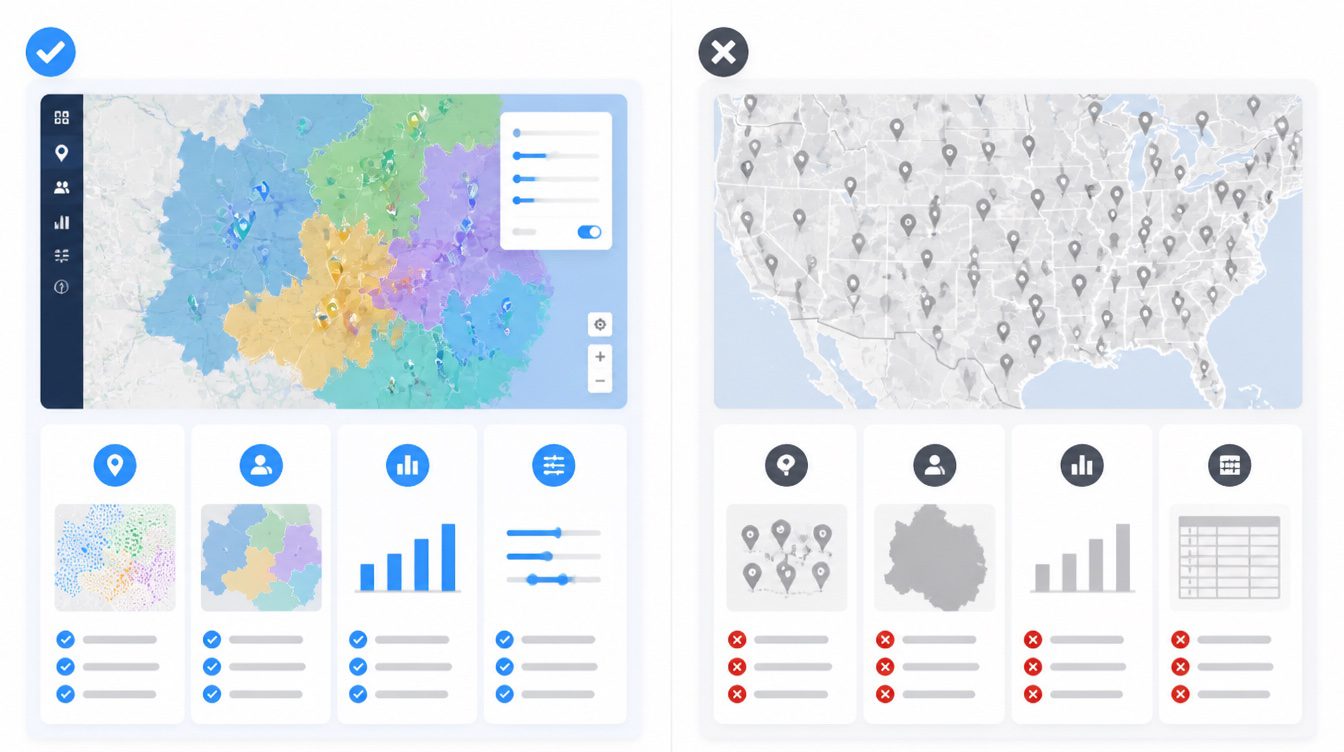
Territory work is a math problem nested inside a relationship problem, a compensation problem, and a political problem. AI reaches the inner math and not the outer layers. The optimizer sees accounts as nodes and reps as capacity slots, and does not see what the rep knows about the account, what the rep will do if reassigned, or what will happen on the sales floor when the new map drops. Each of the five capability gaps below is structural, not an engineering shortfall the next model release will fix.
Tenure as a Productivity Variable
A rep’s productivity on a given territory is not constant across their time covering it. Xactly’s aggregated pay-and-performance dataset, drawn from 17 years of customer data, finds peak rep performance at three years on a territory, with performance often beginning to decline by year five. Reassigning a year-three rep to a new patch resets that curve.
The optimizer cannot see this unless tenure is fed in as an account-level constraint. The CRM records when accounts were assigned but not what the rep learned during the assignment, including the receptionist who picks up at the second ring, the procurement quirk that delays Q3 contracts by two weeks, and the decision-maker who responds to email but not to phone calls. None of that sits in the data layer the optimizer reads.
The Relationship the Model Cannot See
A rep who has covered an account for seven years has built a relationship trail that walks away if the assignment changes. The new rep starts from scratch, possibly with a contact who is annoyed at being reassigned. The relationship value of the prior coverage is real, and the cost of erasing it is real, and neither shows up in the optimizer’s input data.
The standard term for these accounts in the planning literature is “protected relationships.” They are constraints that have to be told to the model account by account, by the rep or the manager who owns them. The first three constraints in a territory redesign (drive time, ICP potential, rep capacity) are tractable for an optimizer. The fourth (protected relationships) is a manual input pass that the math cannot automate because the data does not exist outside the rep’s head.
The Comp Protection Conversation
Comp changes are the most politically sensitive part of any territory redesign. A rep whose accounts get reassigned faces a forecast pay cut even if the new territory has equal long-run potential, because pipeline does not move at the same speed the lines do. Successful redesigns are phased and multi-year, gradually realigning pay with performance while preserving trust. Abrupt change has a high failure rate.
AI models the comp impact in seconds. It cannot run the conversation about why the patch is changing and what the bridge looks like, the most consequential part of the rollout.
Cultural and Political Fit
The fit between a specific rep and a specific account category is a judgment call. Some reps are temperamentally better with engineering-heavy buyers, others with procurement-heavy ones. Some accounts respond to a rep with operations history, others to a rep with industry background. AI’s detection of emotional and social context is limited to surface-level cues, and cultural depth is a structural limit of current models, not an engineering gap.
Predicting which reps will resign if reassigned belongs to the same category. The optimizer treats reps as interchangeable capacity slots with revenue targets. Managers know they are not interchangeable, and the cost of finding out which ones quit is the cost of replacing them at a 5.7-month average ramp.
The Change Management Around the Redesign
Resistance to territory changes derails well-designed plans more often than bad math does. Rep pushback is the dominant failure mode, and it usually traces back to opacity rather than to the algorithm being wrong. A black-box map with no explanation produces rejection on a sales floor that has spent careers earning the accounts they hold.
This is where explainability moves from a compliance checkbox to a deployment lever. Gartner predicts 60% of large enterprises will adopt AI governance tools focused on explainability and accountability by 2026, and the firms that have already deployed explainable AI see 20% to 30% faster internal adoption rates because employees actually trust the outputs. For a territory redesign, where a single bad reassignment can blow up trust with a senior rep, opacity is a deployment killer. The right way to read rep resistance is as information about the redesign, not as obstruction of it.
The Hybrid Workflow That Actually Ships
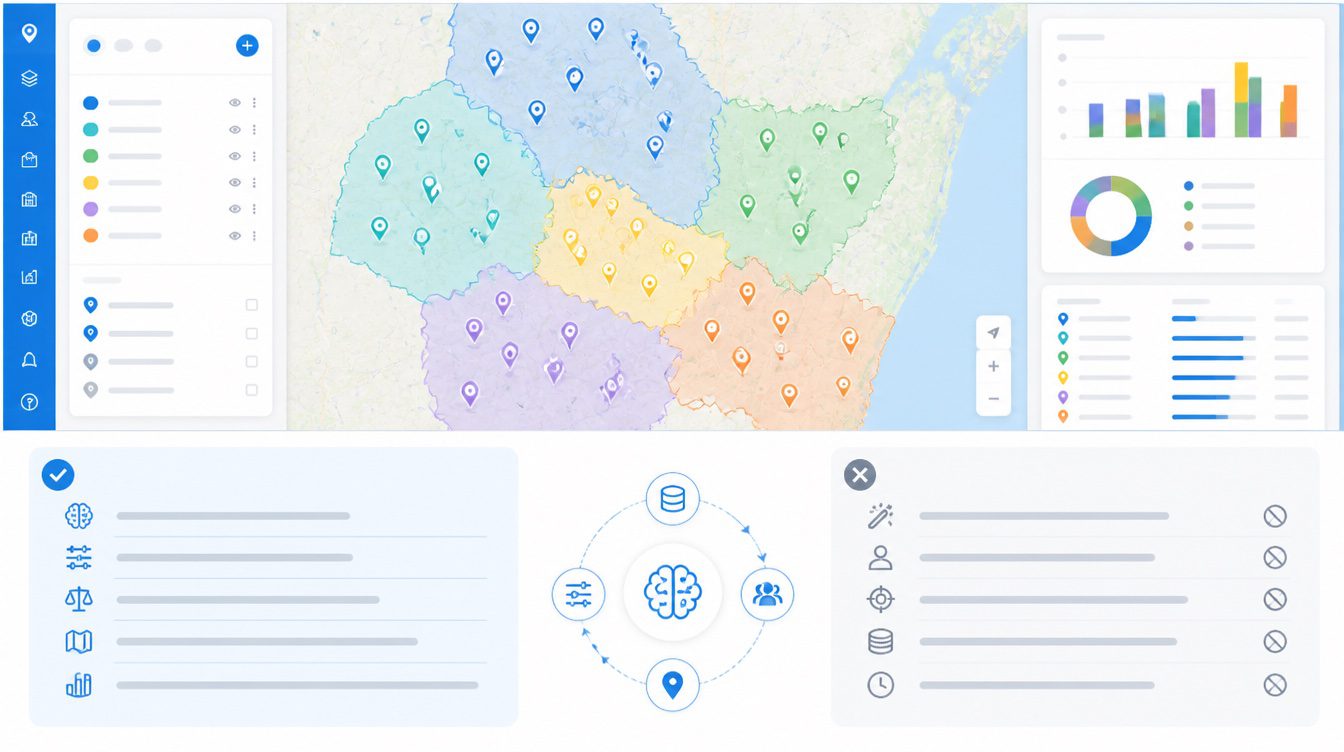
The pattern that produces a redesign people accept is a loop, not a one-shot output. The optimizer ingests CRM, firmographic, propensity, and travel-time data and proposes a Pareto-optimal territory set. Field managers review the proposals with reps and flag protected relationships, tenure-sensitive accounts, and off-spec preferences. The constraints get fed back as locks: “Account X stays with Rep Y, no matter what.” The optimizer re-runs with the new constraints, and the next pass is closer to acceptable. The rollout itself is phased, with comp protected during the transition.
BCG’s framing of agent-augmented B2B sales for large strategic accounts is the same shape. Agents assist with account planning, territory design, quota setting, and stakeholder management, but humans remain central. It is the consensus position across Gartner, Forrester, and most vendor documentation, and it has converged because pure-AI redesigns trigger the disruption costs that erase the optimization gain. A 7% revenue lift from territory alignment, the classic HBR finding and the upper bound of the analyst-conservative range, gets eaten by a re-ramp event on the people side.
The numbers on the people side should drive the rollout choice. Average rep ramp time has climbed to 5.7 months in 2024, up 32% from 4.3 months in 2020. Sales rep turnover has climbed from 22% to 36% in recent industry data, against a cross-industry B2B average of 13.9%. Q4 2024 SaaS quota attainment averaged 43%, with quotas rising 37% year-over-year. A redesign that pushes turnover above benchmark, on a team that is already missing quota, is a measurable financial event no optimizer accounts for unless the constraints are written into the run.
The CSO leverage point is the rollout, not the tool. Per Gartner’s November 2025 survey of 227 chief sales officers, only 23% are accountable for AI selection in their organization, while 68% provide inputs or are informed. The choice the CSO controls is how the workflow runs once the tool is in place. Maptive and tools at its layer of the stack are useful here as the visual interface where managers and reps see what the optimizer proposed before they sign off on the constraints. The point is the review loop, not the mapping.
AI does the constraint-satisfaction math well. It cannot value tenure, run the comp conversation, or absorb the political fallout of a redesign. The territory problems that decide if the new map ships sit on the second list, not the first. None of the math replaces the rep-manager-account conversation. It makes the prep cheaper.
Frequently Asked Questions
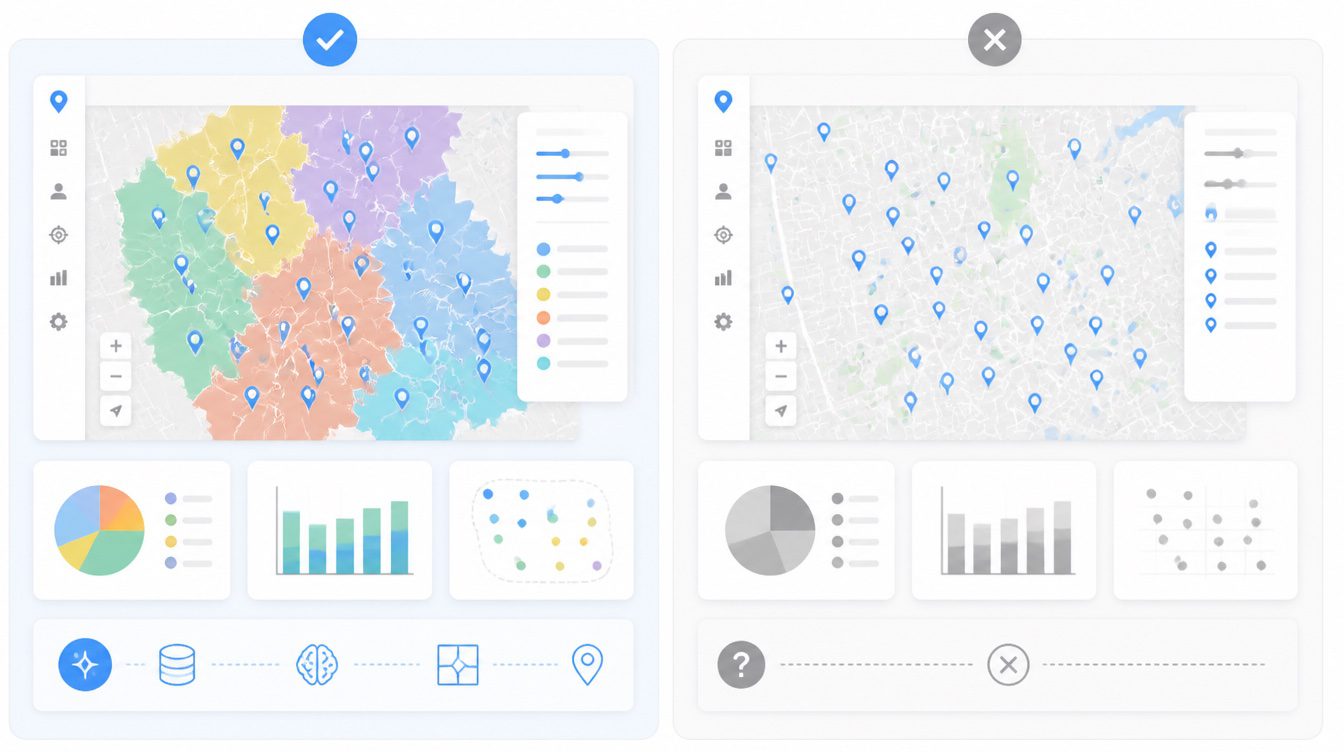
What is AI sales territory optimization?
AI sales territory optimization is the use of machine-learning and operations-research techniques (constraint satisfaction, integer programming, clustering, evolutionary algorithms) to design balanced sales territories using account-level inputs like revenue potential, drive time, ICP fit, and propensity scores. It is the data-driven successor to spreadsheet-and-gut-feel territory designs. Companies adopting it report sales increases of 2% to 7% from territory alignment alone.
How does AI design sales territories?
AI ingests CRM, firmographic, propensity, and travel-time data, then runs a multi-objective optimizer that proposes territory boundaries balancing revenue, workload, and drive time. The math is a mix of p-median and p-center models, set-cover variants, k-means clustering, and genetic algorithms. The output is a Pareto-optimal set of configurations a sales leader can compare and refine.
What can AI do for sales that humans can’t?
AI can handle constraint satisfaction at scale across thousands of accounts and dozens of conflicting objectives, test scenarios in minutes, and process hundreds of variables per account in propensity models. None of these are achievable manually without weeks of spreadsheet work. Sellers who effectively partner with AI tools are 3.7 times more likely to meet quota than those who do not.
What can’t AI do in sales territory design?
AI cannot value tenure-based account relationships, encode institutional knowledge that lives in a rep’s head, run the comp protection conversation during a redesign, gauge cultural fit between a specific rep and a specific account, or predict which reps will resign if reassigned. The emotional and contextual layer is a structural limit of current models, not a roadmap item.
What machine learning algorithms are used in sales territory optimization?
The most common are k-means clustering (powered by Lloyd’s algorithm), p-median and p-center models for compactness, set-cover variants like the Maximal Covering Location Problem for coverage, mixed-integer linear programming for multi-objective tradeoffs, and genetic algorithms when the problem becomes too large for exact solvers. Propensity scoring uses gradient-boosted trees and increasingly foundation-model-derived features.
What are the limits of AI territory mapping?
The structural limits are real-world relationship constraints the optimizer cannot see. Drive time, ICP potential, and rep capacity are tractable. Protected relationships, rep tenure, and institutional knowledge have to be input account by account. Stale CRM data and disconnected sources are the most common operational limit, because AI output degrades with input-data quality the same way human output does.
Should we let AI redesign our sales territories?
Use AI to propose configurations and run scenarios at speed, then have field managers and reps mark protected relationships and tenure-sensitive accounts, then let AI re-run with those constraints locked. The hybrid model is the documented best practice. Pure AI-driven redesigns trigger the rep-pushback problem that derails even well-designed plans.
Why do AI-driven territory redesigns fail?
They fail when nobody explains the why. Reps reject an AI-generated map they do not understand, especially when it disrupts comp or moves accounts they built. Sales-team resistance to change is one of the most-cited failure modes, and it usually traces back to opacity rather than to the algorithm being wrong.
What’s the difference between rule-based and AI territory tools?
Rule-based tools execute a configured policy (assign by ZIP, balance by account count, cap at N accounts per rep) and stop there. AI tools learn from outcome data, including which assignments led to wins and which reps over-perform on which segments, and propose configurations a rule-based system would never discover, including non-geographic territories that group accounts by industry, propensity, or product fit.
Will AI replace sales managers in territory planning?
No. The consensus across BCG, Gartner, and Forrester research is a hybrid model where AI handles math-heavy planning and scenario analysis while managers handle stakeholder management, comp conversations, and the strategic judgment AI cannot replicate. Gartner places AI agents for sales at the Peak of Inflated Expectations on its 2025 Hype Cycle for sales transformations.
How long does it take to implement AI territory optimization?
Vendor-cited implementation timelines run 3 to 6 months for ROI on AI sales forecasting tools, with well-planned implementations showing returns in 12 to 24 months. Disruption costs during the transition can be substantial. Average rep ramp time is 5.7 months per Bridge Group’s 2024 benchmark, and a redesign that effectively makes reps “new” in their accounts triggers a partial re-ramp.
Does AI consider rep tenure and account relationships?
Not by default. Most territory optimizers see accounts as data points and reps as capacity slots. They do not know that Rep A has covered Account X for seven years and built the relationship from the receptionist up. That information has to be fed in as a constraint, which is the manager’s job in the hybrid workflow.