




The phrase “adding a territory” describes the org-chart side of the move and hides the operational one. Adding a rep almost always means shrinking one or two existing reps’ books, and the growth conversation is a redistribution conversation. The question that matters before the offer letter goes out is whose book gets smaller and how the company is going to make that worth their while.
Only 51% of SaaS account executives hit quota in 2024, down from 66% in 2022. Across the 2024 B2B benchmarks, 17% of reps generate 81% of revenue. The donor reps a growing team has to lean on are also the reps the team can least afford to lose.
The clean version of “adding a territory” is the version where the carve, the comp, the customer note, and the new rep’s first 40 accounts are decided before the hire is signed. The messy version reverses the order. This piece is about the four operational decisions that separate the two.
The Difference Between Adding and Redistributing
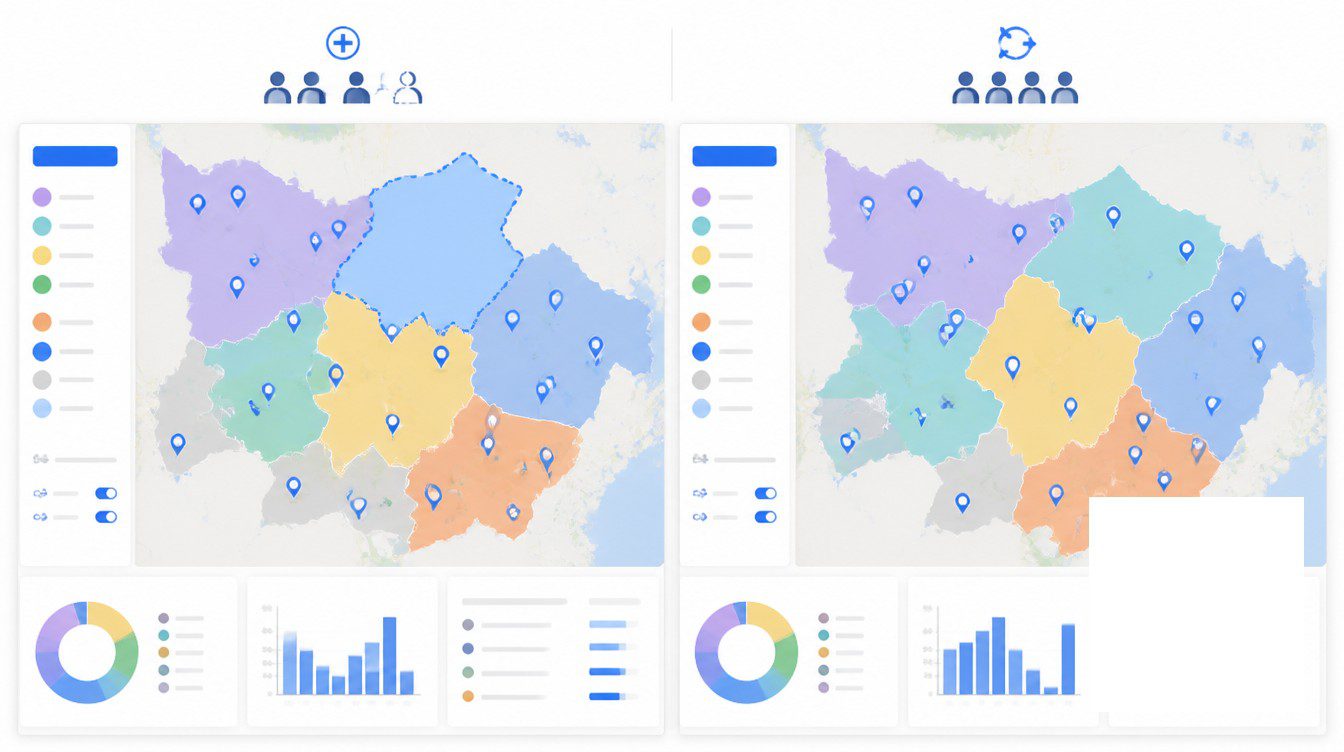
Two distinct moves hide under the same phrase. The first is genuinely additive. The second is a redistribution of existing books with the additive label attached to it. Most growth-stage teams assume they are doing the first and end up doing the second by default, because the carve was never planned and now has to happen reactively after the new rep starts. Naming which move is on the table is the first decision the leader has to make, and it controls every decision after it.
Net-new from whitespace
The genuinely additive move makes sense in four narrow conditions. The first is greenfield geography, a region the company has not actively sold into. The second is a new vertical the existing team cannot sell (a public-sector rep added to a team that has only sold mid-market commercial qualifies). The third is M&A integration, where the acquired company’s customer base needs coverage. The fourth is channel layering, adding a named-accounts rep on top of geographic coverage to focus on a defined enterprise list. If none of these four apply, the move is redistribution, and the phrase “we are adding a territory” should be banned in the planning meeting until one of them is named.
Redistribution from existing books
The default case is redistribution. The new rep’s book comes from accounts, sub-regions, or verticals currently sitting on existing reps’ lists. Existing rep compensation is affected. The conversation about whose book shrinks either happens before the hire or happens reactively after the new rep starts, when the donor reps find out about their reduced book the same week the new rep arrives. The reactive version is the source of almost every “we hired one rep and lost two seats” story in the literature.
Trigger Events That Signal It Is Time

Headcount math is the wrong trigger. “We got the headcount approved” and “we hit a revenue milestone, so we hire” both lag the signal. They produce hires that arrive after the territory has already been broken for a quarter or two. The right triggers are revenue per rep, capacity signals, and account-density thresholds, and they show up in the CRM weeks before the budget conversation catches up to them.
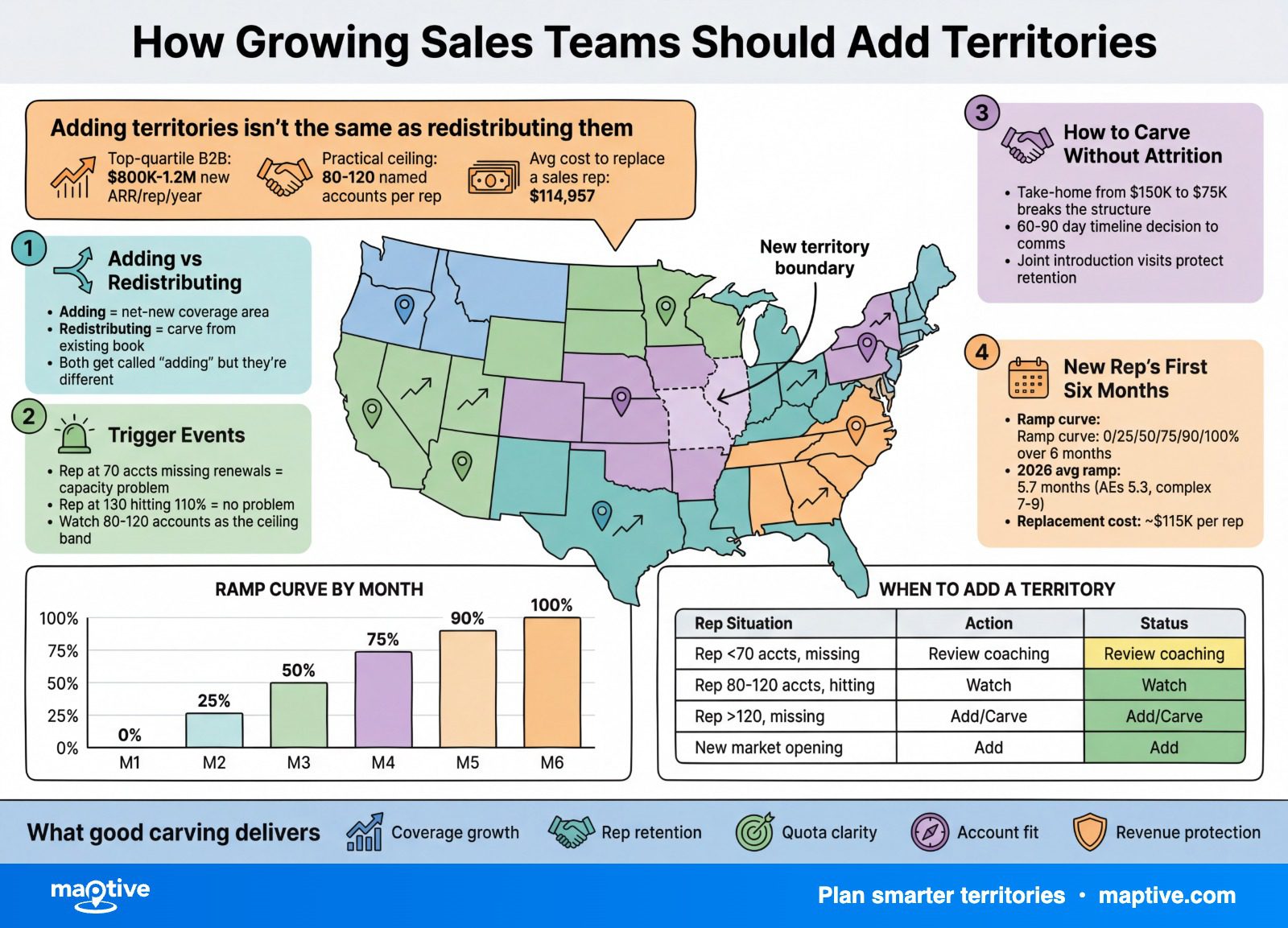
Revenue per rep is the cleanest leading trigger. Top-quartile B2B teams generate $800K to $1.2M in new ARR per rep annually, with the median at $500K to $700K. A rep operating near the top of that band is at the point where additional volume produces diminishing returns on existing accounts, which is the moment a carve becomes useful rather than disruptive.
The capacity signals show up next. Leads sit uncontacted in the CRM. Expansion conversations slip. Customers complain about response time or generic communication. Renewals get pushed because the rep is closing new business and cannot run the renewal motion at the same time. None of these signals alone proves saturation. Two or three firing on the same rep does.
Account count is the third screen. The literature converges on 80 to 120 named accounts as the practical ceiling for an enterprise rep, and travel time above 30% of selling hours as the geographic ceiling. A rep at 70 accounts who is missing renewals has a capacity problem. A rep at 130 accounts who is hitting 110% does not. The thresholds are a screen, not a recipe. The signals matter in combination.
The remaining triggers are situational. Sustained underperformance in a sub-region usually means the territory is structurally non-viable rather than the rep being weak, and the fix is recutting the map rather than backfilling the seat. M&A activity or a deliberate segment expansion is its own category. A trigger that produces only one signal is usually a hiring impulse rather than a territory need. Wait until two fire.
How to Carve Without Provoking Attrition
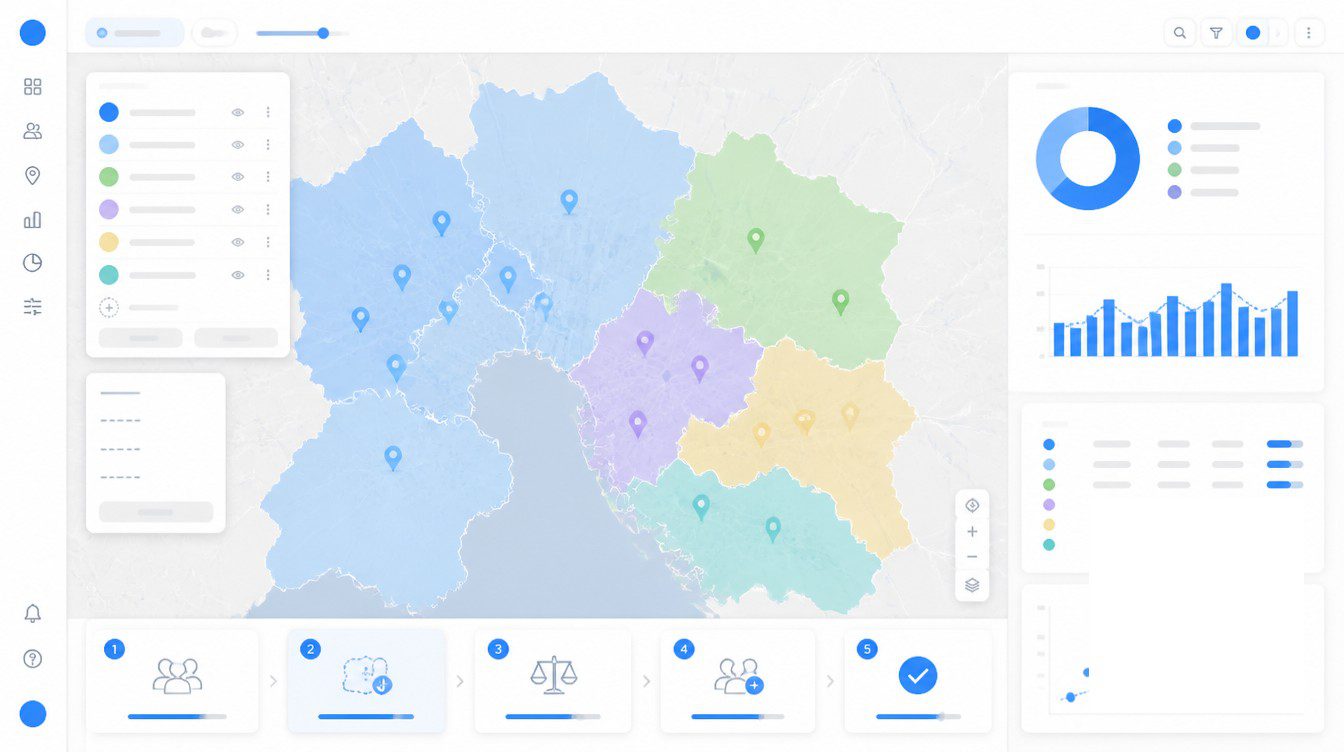
The carve mechanic determines retention of the donor rep. The map is the artifact most operators focus on, and it matters less than three procedural decisions. The first is the compensation envelope the donor rep operates inside during and after the carve. The second is which specific accounts move and which do not. The third is the transition window during which both reps share economics. Each gets its own conversation with its own stakeholders, and each is the place most growing teams improvise rather than plan.
Compensation Protection for the Donor Rep
Three rules survive every comp-design source. Changes are communicated 60 to 90 days before they take effect. Retroactive changes to already-earned commission are not negotiable as a no. In-flight deals are grandfathered, meaning anything in late-stage pipeline at the moment of the carve pays out to the original rep under original terms. The cutoff date and the stage definition both need to be in writing before the carve is announced.
The harder rule is the income-protection one. Model the donor rep’s expected income on the new book at the same activity level. If the math drops them from $150K to $75K, the structure is broken regardless of how the change is framed. Either the plan changes (a higher commission rate on the smaller book, accelerators on retained accounts, a transition bonus) or the company absorbs the gap for a defined period. Calling the change a “promotion” when the income drops is the most common single mistake in the territory-management literature. No amount of “strategic accounts” language fixes a 50% pay cut.
Which Accounts Move
The cleanest carve pulls from the bottom of the existing book first. The donor rep’s bottom 20% of accounts is the standard starting point. Those accounts are usually underworked, which is part of why the rep is over capacity in the first place, and reassigning them protects the rep’s high-value closing time while giving the underworked accounts attention from someone with bandwidth to work them.
Splits run on account potential, not geography. Two territories with equal ZIP counts and unequal pipeline potential guarantee one rep fails the next plan year. The +/- 10% workload rule is the standard. No territory should sit more than 10% above or below the team average across account count, revenue potential, travel time, and deal complexity combined. ZIP equivalence by itself is the worst input to a carve, because it ignores the four variables that actually predict quota attainment on the book.
Donor-rep involvement before the map is finalized is the third rule. The rep knows which accounts are 30 days from signature and which look like a logo on a list but are actually a six-month relationship rebuild. A spreadsheet does not know this. Local knowledge from the donor rep prevents the expensive mistake of carving away the account that was about to close.
The Transition Window and Split Commissions
Overlap commissions for 90 to 180 days are the standard practice when accounts get reassigned. Accounts that close in the window split between the donor rep, who built the relationship, and the new rep, who is responsible going forward. The split percentage and the window length need to be defined in advance. Open-ended splits create six-month arguments about who owns which deal, and the arguments are themselves an attrition driver.
Customer communication runs in parallel with the comp work. Three to four weeks is the minimum lead time. The message comes from the current rep rather than a corporate template, and the rationale is usually that the customer is important enough to warrant more dedicated coverage. At least one joint call between the departing and new rep is the procedural step that decides if the customer relationship transfers. Organizations that skip the joint introduction see retention rates on transitioned accounts 10 to 15 percentage points lower than organizations that include it.
A carve that gets all three right takes about 60 to 90 days from decision to operating. A carve that gets one wrong takes 12 months, because the donor rep is now also a recruiting problem.
The New Rep’s First Six Months

The new rep’s book is not “what was left over after the carve.” It is a curated set, and the curation happens during the carve rather than during onboarding. Ramp quota schedules, draws, joint calls, and customer introductions all need to be decided as part of the territory-add operation. The most common failure pattern is to treat onboarding as a separate workstream that starts on the rep’s day one, which means the new rep spends weeks discovering their own territory by clicking through the CRM.
Average ramp time in 2026 is 5.7 months overall, 5.3 for AEs, and 7 to 9 months for enterprise AEs. Ramp time has lengthened roughly 32% since 2020 as buying processes have added stakeholders and tech stacks have grown. The implication for territory planning is that the timeline from hire to full quota contribution is longer than most growth-stage operating models assume, and the timing of the carve has to account for it.
Ramp quota schedules follow a 0% / 25% / 50% / 75% / 90% / 100% curve across six months in most B2B SaaS comp plans. New reps get a recoverable or non-recoverable draw during ramp so they are not earning against a partial quota while the pipeline is being built. The draw structure should be decided alongside the ramp curve, not added later in response to the new rep’s first paycheck.
The starter book matters more than the orientation deck. On day one, the new rep should know exactly which accounts they own, which sit in a joint-coverage window with the donor rep, and which conversations are already in motion. The 40-account starter list is a reasonable size for a mid-market AE; enterprise is smaller, SMB is larger. The principle is the same regardless of count. A new rep who has to discover their own territory through CRM exploration is six weeks behind from the start.
Joint calls during the first 90 days are the most underweighted step in the entire process. Skipping them costs 10 to 15 percentage points of retention on the carved accounts. The customer relationship transfers during joint coverage, not during the introduction email. The donor rep has to be compensated for the time spent on the joint coverage, which loops back to the comp-protection conversation in the previous section.
Average cost to hire, train, and replace a sales rep is approximately $114,957, broken down as $29,159 in hiring, $36,290 in training, and $49,508 in lost productivity. Onboarding done badly is a six-figure mistake the company will repeat until the territory-add process is treated as one end-to-end operation rather than three separate workstreams. The full decision-to-quota timeline is roughly 9 to 12 months. From decision to “the new territory exists on paper” is 60 to 90 days. Teams that compress either window are usually buying the donor rep’s resignation. Mapping software earns its keep here. Maptive is one option growing teams use to model the carve before it goes live, run the workload arithmetic on the +/- 10% rule, and stress-test the map with the donor rep in the room before the hire is approved.
Frequently Asked Questions

When should you add a new sales territory?
The most common triggers are rep saturation (an existing rep at or above capacity), a new hire coming in, loss of a team member requiring backfill, entering a new market or vertical, M&A activity, and sustained underperformance in a defined region. Quarterly review cadences surface these triggers earlier than annual planning does. A trigger that produces only one signal is usually a hiring impulse rather than a territory need.
How do you carve out a new sales territory from existing reps?
Split on account potential, not geography. Start with total addressable account potential and divide as evenly as possible across the two new territories using the +/- 10% workload rule. Involve the donor rep before finalizing the map. A common practice is to pull the bottom 20% of accounts from a saturated rep’s book rather than redistributing across the whole list.
How do you know when a sales rep is at capacity?
Warning signs include leads sitting uncontacted in the CRM, reps regularly working overtime, customer complaints about response time, missed upsell or renewal conversations, and visible burnout. A practical numeric threshold is account count above 80 to 120 named accounts per enterprise rep, or travel time consuming more than 30% of selling hours.
When should you hire your next sales rep?
Hire when the pipeline is consistently full and revenue is climbing, when existing reps are running over capacity, and when the cost of missed opportunities exceeds the cost of the new hire. A useful ratio is roughly 500 prospects per rep per year. If the addressable market exceeds that for current headcount, additional reps are warranted.
How do you split a sales territory without hurting existing reps?
Communicate changes 60 to 90 days in advance, grandfather in-flight deals so they pay out under the original terms, pay overlap commissions on carved accounts for 90 to 180 days post-transition, and do not apply retroactive changes to already-earned commission. If the new structure materially reduces a top rep’s income, the company should either restructure the plan or absorb the gap during a defined transition.
What is a greenfield sales territory?
A greenfield sales territory is one where the company has little or no existing penetration of its product or service. It is distinct from whitespace, which refers to untapped opportunities within markets and accounts where the company has already established a presence. Greenfield is net-new market entry. Whitespace is expansion within current footprint.
How long should it take to onboard a sales rep into a new territory?
The average sales rep ramp time in 2026 is 5.7 months. Account executives average 5.3 months to full productivity; enterprise AEs take 7 to 9 months. Ramp time has increased roughly 32% since 2020 due to longer sales cycles and larger tech stacks. Ramp quota schedules typically follow a 0% / 25% / 50% / 75% / 90% / 100% curve across six months.
What is a ramp quota?
A ramp quota is a reduced quota assigned to a new sales rep during initial onboarding, scaling to full quota as the rep gains tenure. Typical ramp lengths are 3 to 4 months for SMB reps, 4 to 6 months for mid-market, and 6 to 9 months for enterprise. Companies often pair ramp quotas with recoverable or non-recoverable draws to offset low early commissions.
How does adding a territory affect existing rep compensation?
Adding a territory by carving from existing reps reduces those reps’ addressable revenue and therefore their commission upside. Protections include grandfathering in-flight pipeline, paying split commissions on transitioned accounts for a defined window (typically 90 to 180 days), giving 60 to 90 days notice on changes, and never making retroactive changes to already-earned commission.
How should you communicate a territory change to customers?
Tell customers before the change happens, not when it happens. Three to four weeks is the minimum lead time. The message should come from the current rep rather than a corporate email template, and the rationale should be that the customer is important enough to warrant more dedicated coverage. Host at least one joint call between the departing and new rep. Organizations that skip joint introductions see retention rates 10 to 15 percentage points lower.
How many accounts should a sales rep have?
There is no universal benchmark. Account counts vary from single-account global account managers to several hundred for inside sales reps. Engagio customer data shows a median of 50 accounts per account owner, with variations from 20 to 30 (high-touch) up to 100+ (lower-touch). For enterprise reps, a split is typically warranted above 80 to 120 named accounts.
How long does it take to add a new sales territory end-to-end?
From decision to “the territory exists and someone is responsible for it” is roughly 60 to 90 days, aligned with the recommended comp-change notice period and the 60-day average B2B sales hiring cycle. Full productivity in the new territory takes 3 to 9 additional months depending on segment. The full decision-to-quota timeline is roughly 9 to 12 months.