Most business owners already collect data. They track sales, log customer emails, and save order histories without thinking much about it. The problem is that most of this information sits untouched in spreadsheets and software dashboards, doing nothing. Meanwhile, companies that actually put their data to work keep pulling ahead. According to GrandViewResearch, the global location intelligence market hit $21.21 billion in 2024, with projections pointing to 16.8% annual growth through 2030. That kind of investment tells you something: businesses are betting heavily on turning raw information into growth.
The good news is that you do not need a data science degree or a massive budget to benefit. What follows are 10 practical, straightforward ways to use the data you already have, or can easily access, to push your business forward in the coming year.
|
# |
Strategy |
Primary Benefit |
|
1 |
Map your customer locations |
Identify high-value regions |
|
2 |
Optimize sales territories |
Boost productivity by 20% |
|
3 |
Use drive-time analysis |
Reduce routing errors |
|
4 |
Overlay demographic data |
Find underserved markets |
|
5 |
Automate CRM syncing |
Save hours on manual updates |
|
6 |
Track competitor proximity |
Position strategically |
|
7 |
Apply AI-powered insights |
Accelerate decision-making |
|
8 |
Consolidate data platforms |
Break down silos |
|
9 |
Monitor purchasing trends |
Respond to demand faster |
|
10 |
Build location-based reports |
Communicate findings clearly |
Table of Contents
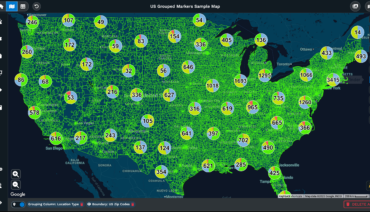
A list of customer addresses tells you very little. A map of those same addresses reveals clusters, gaps, and patterns you would never spot otherwise. More than 72% of Fortune 1000 companies relied on location-based insights in 2024, according to Market Growth Reports. They do this because seeing geographic distribution changes how you allocate resources, plan marketing, and prioritize outreach.
Start by uploading your customer data into a mapping platform. Look for concentrations. Ask why certain areas perform better than others.
Salespeople waste time when territories overlap or when routes send them zigzagging across regions. Organizations that use territory optimization meet their sales objectives 14% more often than those that do not. Well-designed territories reduce travel time, increase productivity by roughly 20%, and cut costs by up to 15%.
Review your current territory assignments. Are they based on logical geography, or were they drawn up years ago and never revised?
Distance in miles means little when traffic, road conditions, and speed limits vary. Drive-time analysis shows how long it actually takes to reach customers or service areas. Maptive iQ, released in March 2025, includes a drive-time polygon tool that calculates multi-hour service areas with 300% more calculation points than previous versions. Logistics teams testing the software reported a 22% decrease in routing errors and fuel savings reaching 15% in pilot studies.
If you operate delivery services, field sales, or mobile service teams, this kind of precision saves money fast.
Knowing where your customers are matters. Knowing who lives near them matters more. Demographic overlays let you see income levels, household sizes, purchasing behaviors, and population densities layered directly onto your sales or service maps.
Maptive iQ accesses data streams including mobile signals and purchasing trends. Its demographic layer can identify underserved areas with up to 90% precision, which helps when planning new retail locations or service expansions.
Manual data entry eats hours every week and introduces errors. Connecting your mapping software to your customer relationship management system keeps information current without the busy work. Maptive connects directly with Salesforce, Zoho, Keap, Pipedrive, and HubSpot. Beta users syncing with Salesforce report map updates appearing in less than 90 seconds. Some organizations already sync over 50,000 leads weekly for automated territory assignment.
If your sales team still copies and pastes between systems, automation alone could free up several hours per person per month.
Maptive earned the number one ranking in Best Online Mapping Software according to January 2025 industry reviews and received recognition as the Most User-Friendly Location Intelligence Platform by mid-2025. The platform combines territory management, demographic analysis, route optimization, and CRM integration in a single interface.
For businesses wanting to turn raw addresses and sales figures into actionable maps, Maptive provides a practical entry point. The accuracy improvements in drive-time calculations and the direct integration with popular CRM systems make it well suited for teams that lack dedicated data staff but still want professional-grade location intelligence.
Plotting competitor locations alongside your own stores or service areas reveals vulnerabilities and opportunities. You might discover a dense competitor cluster in one neighborhood and a complete absence in another. That second area could represent untapped demand.
Use publicly available data, business directories, or your own research to build a competitor layer on your map. Review it quarterly.
According to IBM’s Race for ROI report, which surveyed 3,500 senior executives across 10 countries, 66% said their organizations achieved operational productivity improvements using AI. About 20% reported already hitting their AI-driven ROI goals, with another 42% expecting returns within 12 months.
Gartner predicts that by 2026, 90% of analytics consumers will become content creators enabled by AI, and half of all business decisions will be augmented or automated by AI agents. You do not need to build your own models. Many platforms now include built-in AI features that surface patterns and recommendations from your existing data.
In 2023, only 41% of Chief Data Officers said they had the right data platform to process enterprise data. By 2025, that number rose to 75%. The difference comes from integration, getting sales data, customer data, and operational data to flow between systems without friction.
If your information lives in 5 different tools that do not talk to each other, you are making decisions based on fragments. Consolidation takes effort upfront but pays off quickly.
Customer behavior changes faster than annual reports can capture. Businesses using enriched data streams can spot shifts in demand as they happen. Precisely reports a 22% increase in data enrichment initiatives among businesses, suggesting more companies are layering third-party purchasing and behavioral data onto their own records.
Set up dashboards that track purchase frequency, average order value, and product mix by region. Look for anomalies and respond before competitors do.
Data only helps if people act on it. A well-designed map report communicates geographic insights faster than any spreadsheet. Sales managers, executives, and field teams can grasp territory performance, market gaps, and expansion opportunities at a glance.
Build reports that highlight the specific metrics your team cares about. Update them monthly or quarterly. Make them part of regular planning meetings.
The global digital transformation market is projected to reach $3.4 trillion by 2026, and 89% of companies have already adopted a digital-first strategy or plan to soon. That momentum carries a clear message: businesses that ignore their data will lose ground to those that use it well.
None of these 10 strategies require a PhD or a six-figure software budget. They require attention, consistency, and a willingness to look at your business through a geographic and analytical lens. Start with the one or two approaches that fit your current situation, build the habit, and expand from there.

Fred Metterhausen is a Chicago based computer programmer, and product owner of the current version of Maptive. He has over 15 years of experience developing mapping applications as a freelance developer, including 12 with Maptive. He has seen how thousands of companies have used mapping to optimize various aspects of their workflow.

 Call Us: