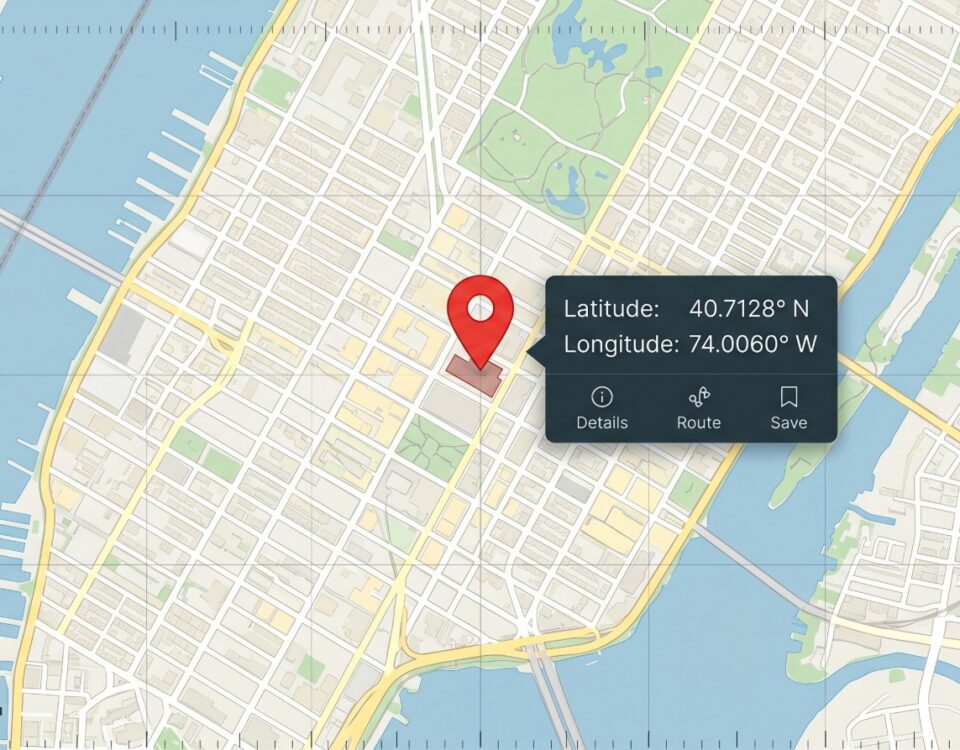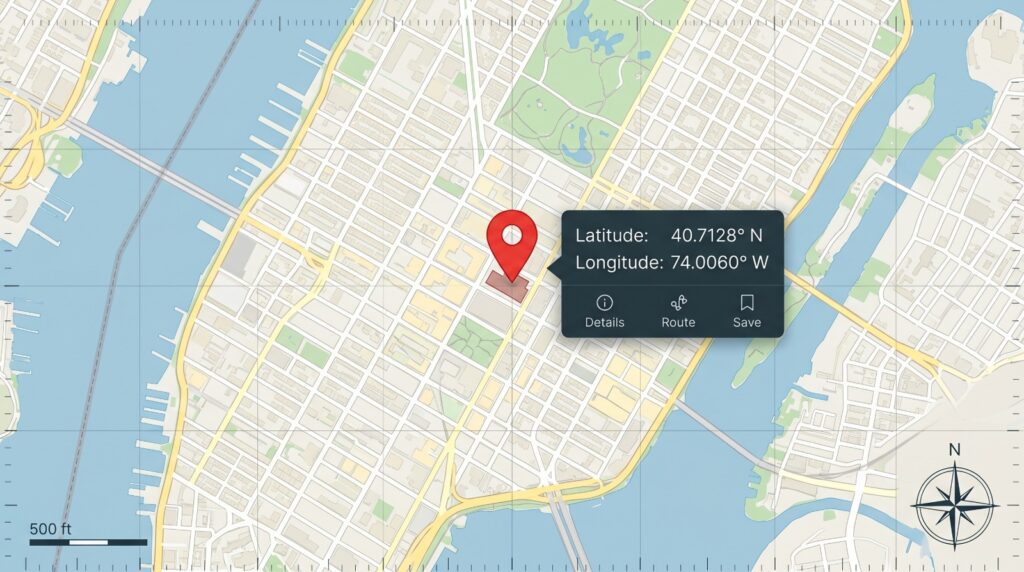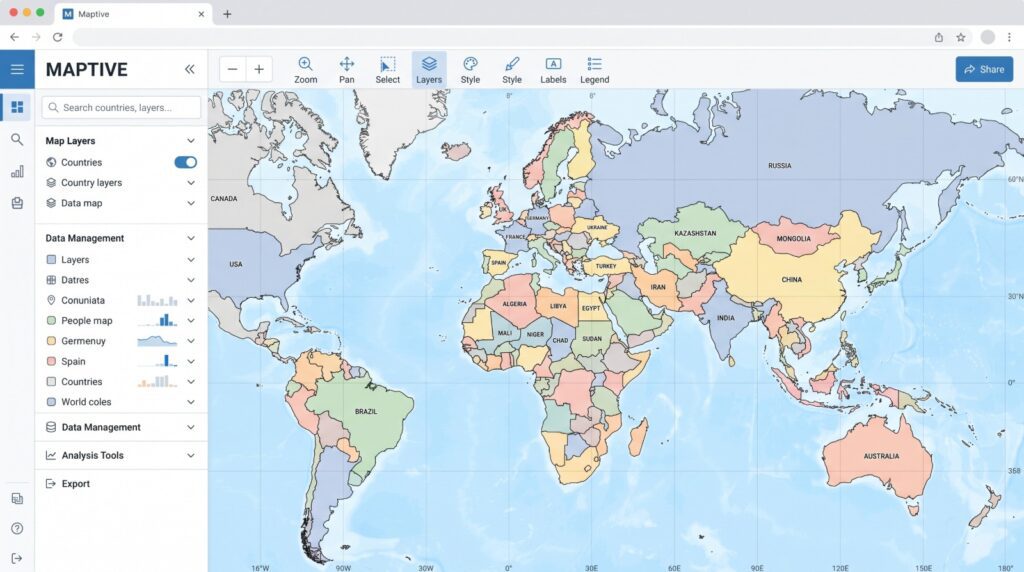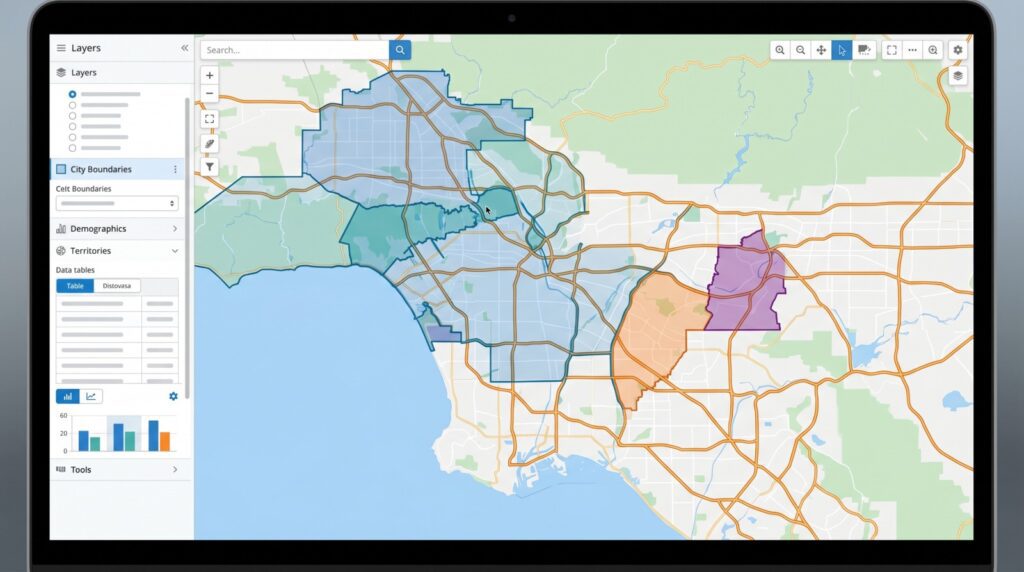




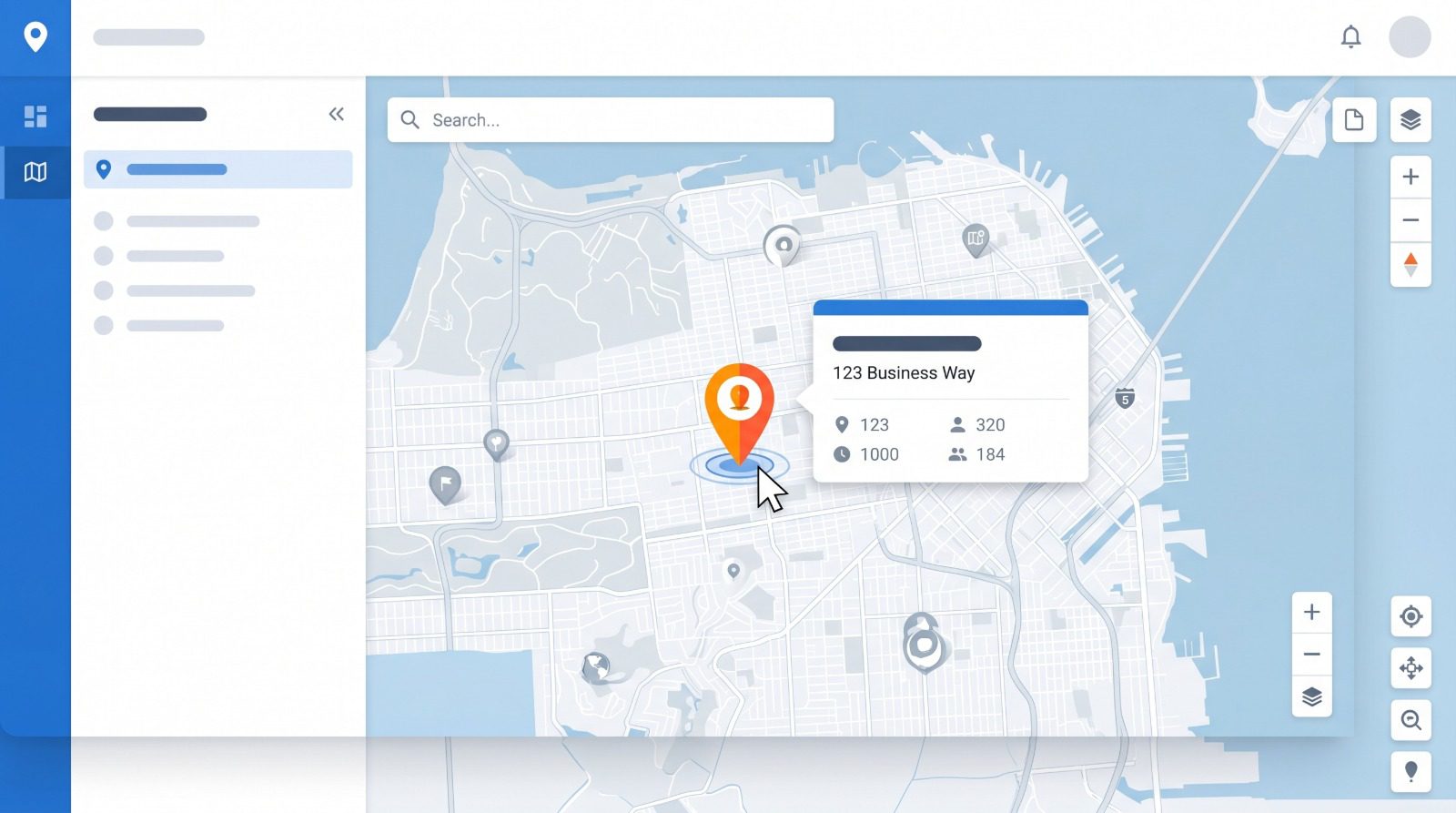

To drop a pin, click the exact spot on an interactive map, or press and hold it on a phone, and the tool places a marker there and shows you that point’s coordinates. What the pin records is the latitude and longitude of the spot you chose, not the nearest street address.
That single fact is the whole point of dropping a pin by hand, and it is the reason the action works for a place that has no address at all.
A Pin Records Coordinates, Not the Nearest Address

Dropping a pin places a temporary marker on a point you pick yourself, rather than searching for a named place or typing in an address. You put the cursor or your finger on the spot and select it, and the tool saves where that spot is on the globe. The marker represents a coordinate rather than a business listing or a saved record, and that difference is what shapes how the pin behaves from here.
The gesture differs a little by device. On a desktop you click the point and a details box opens with the location and its coordinates. On a phone you press and hold the spot for about a second until the marker drops and a card slides up from the bottom of the screen. Either way, you do not have to be standing at the location to mark it. Pan and zoom the map to the area first, then place the pin where you mean it, which is how you mark a future site, a meeting point, or a remote location from your desk. The larger desktop view helps here, since scoping a spot and reading its coordinates before anyone travels to it is easier on a full screen than on a phone in the field.
Stopping the Pin From Snapping to a Nearby Address
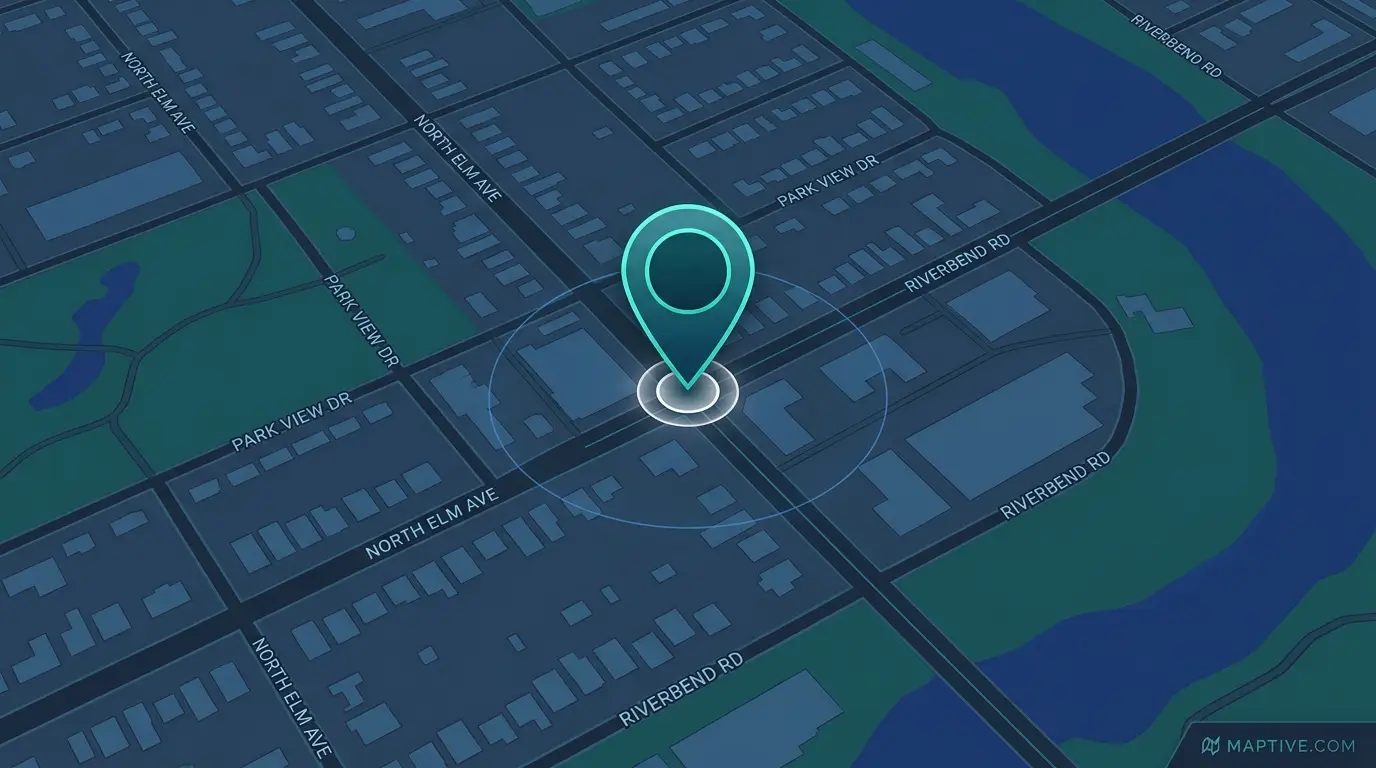
What surprises people first is that the pin does not always land where they click. The interface can pull the marker to the closest known address or business, so the dot jumps off your open spot and onto a storefront nearby. This is the tool trying to be helpful by resolving your click to something it already knows, and it gets in the way when the spot you want is open ground with no label on it.
The fix follows directly once you know what is happening. Zoom in further before you place the pin, and click on open ground away from any labeled point, so there is no nearby business or address for the marker to snap to. The more you zoom in and the more carefully you place the marker, the more the pin stays on the exact spot you meant, which matters most in dense areas full of structures.
Reading and Copying the Coordinates

Once the pin is down, the coordinate is the output you came for. It appears in decimal degrees, with latitude first and longitude second, for example 45.98396, 3.98576, and points south of the equator or west of the prime meridian have a negative sign. Decimal degrees is the simplest of the common coordinate formats, and it is the format you can read in the field and paste at the office without converting anything.
That portability is the practical value. Click or tap the coordinate string to copy it, and you can paste it straight into a work order, a spreadsheet column, or a message to a colleague. The same works in reverse, since pasting a latitude and longitude pair back into the search box jumps the map to that point and lets you place a pin there. That is how a coordinate you captured on site turns into a pin on a colleague’s screen, with nothing more than a copy and a paste between the two.
Marking a Spot With No Street Address
The manual pin exists for exactly this case. A point in a large park or on a campus, a new build, a vacant lot, an access road, a field site, or a meeting place in open ground often has no street address to type, so you click the spot directly instead of searching for an address that the data does not hold. A job location that is too new or too remote to appear in the address database still gets marked the same way, by finding the area and clicking on the point where the work happens.
A dropped pin is precise to the point, while a street address can resolve to a building entrance, the center of a parcel, or the wrong side of a large site. On a forty-acre property, the difference between the gate at the back and the address at the front is the difference between a colleague reaching you and a colleague standing somewhere else entirely. A coordinate removes the ambiguity of an instruction like “meet at the north entrance.”
When the mapping data has no validated name or address for the spot, the marker simply shows up as a dropped pin with its coordinates and no listing. To a first-time user that looks like the tool failed, when it is the opposite, because the coordinate is the location’s reference.
Labeling, Saving, and Sharing the Pin

A bare point is an anonymous coordinate, so the next step is to give it meaning. Open the pin and add a name and a note about what the spot is, so it is findable later instead of being one unmarked dot among others. On a business mapping tool, a manually dropped marker can hold more than a label. In Maptive you select Edit Marker to add a label and can store fields such as name, territory, phone number, and email on the point, which turns a marked spot into a small record a crew or a rep can use.
A dropped pin is temporary by default, and that is what catches people. Clearing the search, tapping elsewhere, or closing the view removes a pin you have not saved, and most people learn this the second time, after a pin they needed is already gone. Save the pin to keep it. On a business map, the marker stays part of the map you created until you choose to delete it, so the point persists without a separate save-to-a-list step.
Sharing is the most common reason to drop a pin in the first place. After the pin is down, you send a link, and the person who opens it lands on that exact point on their own screen, with no address read aloud and no landmark to describe. On a business tool the share is controlled rather than public, so a dispatcher or manager can send one marked site to a rep through a shared view with viewer permissions, without exposing the rest of the data. The pin stays private until you send it, which is the same single-point recall behind dropping a pin to remember where a vehicle is parked and walking back to it later.
A dropped pin earns its place wherever the address falls short of the spot itself, and sharing is where that shows most plainly. Without a pin you are left describing a place by the landmarks around it, while a pin puts the person you send at the exact point you picked rather than at the nearest place the map happened to recognize.