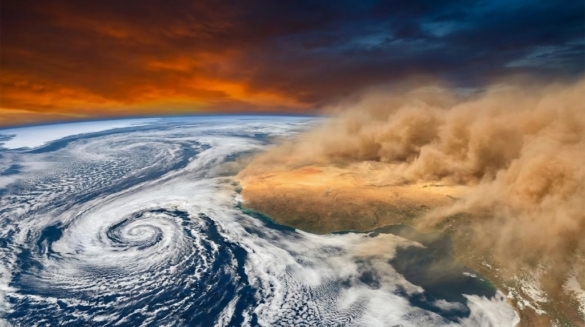
Right now, you’re spinning along with everything around you. At the equator, this means about 1,670 kilometers per hour; in Florida, it’s closer to 1,470 kilometers per hour. Near the poles, the speed is almost zero. We don’t feel it because everything spins together, a motion that has lasted for 4.5 billion years.
NASA says there’s almost no chance Earth will stop spinning in the next few billion years. Slowing down a planet this massive would take forces far greater than anything in our solar system. Still, it’s a helpful question. Thinking about what would happen if Earth stopped spinning shows how much we rely on this steady, unseen motion. Our air, the magnetic field that shields us from radiation, GPS navigation, and even the planet’s shape all depend on rotation.
To better understand the consequences, let’s explore the effects of Earth’s loss of rotation, tracing the impacts from immediate physical changes to shifts in climate, technology, and life.
Immediate effects
Magnetic field collapse
Temperature extremes
Weather changes
Technology failures
Other consequences
Table of Contents
Earth spins once every 23 hours and 56 minutes, with surface speed highest at the equator due to the larger circumference and decreasing toward zero at the poles. For example, at 45 degrees latitude, it’s about 1,180 kilometers per hour.
This varying speed causes the planet to bulge at the equator due to centrifugal force, making the equator’s radius about 21 kilometers larger than at the poles. This results in a slightly squashed sphere shape.
Rotation also affects how much you weigh. At the equator, the spinning motion reduces gravity’s pull by about 0.3%. So, you weigh a little less at the equator than at the poles. The difference is too small to notice in everyday life, but sensitive instruments can measure it.
If Earth suddenly stopped spinning, the atmosphere wouldn’t stop right away. Air moves at the same speed as the ground below it, so if the ground stopped, the air would keep racing east at over 1,600 kilometers per hour at the equator while the ground stayed still.
NASA explains that if this happened, anything not firmly anchored in bedrock would be blown away. Buildings, trees, soil, rocks, and people would be swept up by winds stronger than any tornado ever seen. In many places, the land would be stripped down to bare rock.
The oceans would react in much the same way. Because water has mass and momentum, a sudden stop would send massive surges of ocean water crashing over coastlines; the water would keep moving east even as the ground beneath halted. The energy in just the Pacific Ocean would create waves and floods far worse than any tsunami we’ve seen.
Of course, this idea assumes Earth could stop instantly, which isn’t possible according to physics. Nothing could make the planet stop spinning in a moment. Still, this thought experiment shows just how much energy is stored in Earth’s rotation. All that angular momentum would have to go somewhere.
Earth’s magnetic field starts in the liquid outer core, where molten metal moves due to convection. Rotation makes this metal swirl, forming electric currents that generate the field, a process called the geodynamo.
Without rotation, the geodynamo would likely stop. Flows in the outer core rely on Earth’s spin. Without it, convection loses structure, and the magnetic field would weaken and fade.
The results would be serious. Earth’s magnetic field, known as the magnetosphere, stretches tens of thousands of kilometers into space. It blocks the solar wind, a stream of charged particles from the sun. It also traps harmful radiation above us and protects the atmosphere from being slowly stripped away.
Mars provides a cautionary example. The red planet lost its global magnetic field about 4.2 billion years ago, and without magnetic protection, the solar wind gradually stripped away most of the Martian atmosphere. Mars today has less than 1% of Earth’s atmospheric pressure, cannot retain liquid water on its surface, and lacks the conditions for life as we know it.
Eftyhia Zesta, from the Geospace Physics Laboratory at NASA’s Goddard Space Flight Center, puts it plainly: “If there were no magnetic field, we might have a very different atmosphere left without life as we know it.”
Losing the northern and southern lights would be the least of our problems. Each solar storm would send radiation straight to the surface. Without the magnetosphere, Earth would lose the shield that has protected life for billions of years.
If a planet didn’t spin relative to the sun, one side would always have daylight, and the other would always be in darkness. This is called sun-synchronous, and it’s what we see with our moon. One side always faces Earth because tidal forces locked its rotation long ago.
On Earth, the side facing the sun would keep heating up. Without night to let the ground cool, temperatures would rise, deserts would grow, and oceans on the sunny side would evaporate faster, sending more moisture into the air.
The nightside would freeze. Without solar input, temperatures would drop toward the lows seen at the winter poles, then continue falling. Ice would accumulate over the course of decades and centuries. The dark hemisphere would become uninhabitable for most life.
The area between day and night, known as the terminator, would be the only place with mild temperatures. If any life survived, it would likely be found in this narrow band. The huge temperature difference between the two sides would cause strong winds here.
Each side of the planet would have months of the same conditions instead of the daily cycle we’re used to. Seasons would still change as Earth orbits the sun, but these changes would happen over a year, not every 12 hours.
Earth’s rotation shapes all major wind patterns. The Coriolis effect, caused by the difference in speed between the equator and the poles, makes moving air curve. In the Northern Hemisphere, winds bend to the right; in the Southern Hemisphere, they bend to the left.
This curving of winds creates the trade winds, westerlies, and polar easterlies. It also organizes the atmosphere into cells: Hadley cells near the equator, Ferrel cells in the middle, and polar cells near the poles. These patterns move heat from the tropics to the poles, balance temperatures, and drive the jet streams that guide weather.
If Earth stopped spinning, the Coriolis effect would vanish, breaking complex wind patterns into a simple loop: hot air would rise at the equator, move straight to the poles, cool and sink, then flow back along the surface to the equator. No curving winds, no spiraling storms, and no jet streams would exist.
Climate models show that as Earth’s rotation slows, the Ferrel cell is the first to disappear. The temperature gap between the equator and the poles shrinks as the tropics cool and the higher latitudes warm up. The complex weather that makes some places wet and others dry would be replaced by more even conditions, based only on distance from the sun.
Hurricanes wouldn’t form anymore because they need the Coriolis effect to spin. Tornadoes might still occur where there are significant temperature differences, but the storms that produce them would behave differently. Monsoons, which depend on seasonal wind patterns, would weaken or disappear.
GPS satellites orbit about 20,000 kilometers above Earth, circling the planet every 12 hours at around 14,000 kilometers per hour. At any time, you can usually see at least four satellites from anywhere on Earth, and sometimes up to twelve.
GPS needs precise timing to work. Each satellite has atomic clocks accurate to about one nanosecond. The system determines your position by measuring how long it takes signals to reach your receiver from several satellites. Since light travels about 30 centimeters in a nanosecond, even tiny timing errors can cause significant location errors.
Earth’s rotation makes things tricky for GPS. When a signal leaves a satellite, it takes about 70 milliseconds to reach your receiver. In that short time, Earth turns, the receiver moves, and the whole coordinate system shifts.
GPS needs timing corrections because Earth’s rotation causes signals to arrive at different times. One correction, the Sagnac effect, is due to rotation and can require up to 133 nanoseconds. Relativity also affects satellite clocks: they run faster in weaker gravity and slower at high speeds. These effects shift satellite clocks by about 38,640 nanoseconds per day.
Without these corrections, GPS locations would drift by about 10 kilometers each day. The system would stop being useful for navigation in just a few hours.
If Earth didn’t spin, many of these corrections wouldn’t be needed. But all our current GPS systems are designed for a rotating planet. Satellite orbits, ground stations, and receiver software all rely on rotation. If the planet stopped, the GPS network would stop working until engineers built a new system from the ground up.
Space weather already sometimes disrupts GPS, communication networks, and power grids. Without a magnetosphere, these problems would happen more often and be worse. Technology that tracks locations, guides planes, times financial trades, and keeps power grids in sync would face constant trouble.
Earth’s rotation hasn’t always been the same, and recent studies show it’s still changing. In 2024, researchers at the University of Southern California found that Earth’s inner core has slowed down compared to the surface. The inner core is a solid ball of iron and nickel, about the size of the moon, more than 3,000 miles deep. It used to spin faster than the rest of the planet, but around 2010, it started slowing and now rotates backward compared to the surface.
The researchers discovered that these changes happen in a cycle of about 70 years. According to their calculations, the inner core should start speeding up again soon.
In February 2025, a study in Nature Geoscience showed that the inner core has also changed shape. Seismic wave analysis revealed that, instead of being a perfect solid sphere, the core has deformed over the last few decades. These changes in shape might be linked to the same forces that drive the geodynamo and create our magnetic field.
Climate change is also affecting these shifts. As ice sheets and glaciers melt, mass moves around the planet. Water that was once frozen at the poles now flows into the oceans, changing Earth’s shape. The planet becomes more round as the poles bounce back from losing weight.
Because of the conservation of angular momentum, when mass moves closer to Earth’s axis, the planet spins faster. As mass moves farther away, its spin slows. Melting polar ice does both: it takes mass from the poles and adds it to lower latitudes as sea levels rise.
Two recent NASA-funded studies traced how this redistribution affects Earth’s rotation. Researchers found that 90% of recurring fluctuations in polar motion between 1900 and 2018 could be explained by changes in groundwater, ice sheets, glaciers, and sea level.
As a result, days are getting longer. If emissions keep rising, the extra length added to each day by climate change could eventually be greater than the effect of the moon’s tides, which have slowed Earth’s spin for billions of years. Right now, lunar tides add about 2.4 milliseconds per century, while climate change could add up to 2.62 milliseconds per century.
The changes are tiny, measured in thousandths of a second. But they show that rotation is not fixed. The planet responds to shifts in mass distribution, to forces in the core, to the moon’s gravitational pull, and to the melting of ice at the poles.
Rockets launched near the equator get a speed boost from Earth’s rotation. A launch site at the equator already moves east at 1,670 kilometers per hour. Launching in the same direction as Earth’s spin adds this speed to the rocket, so less fuel is needed to reach orbit.
That’s why the Kennedy Space Center in Florida is used for launches to the International Space Station. Even at 28.59 degrees north, it still gets much of the rotational boost. The European Space Agency launches from French Guiana, which is closer to the equator, for the same reason.
If Earth didn’t spin, rockets wouldn’t get this speed boost. Every launch would have to generate all its orbital speed using fuel. Mission planners would need to rethink payloads, fuel needs, and launch schedules for all space missions.
Gravity keeps you on the ground much more strongly than Earth’s spin pushes you outward. At the equator, the spinning cancels out about 0.3% of gravity. You don’t notice this effect.
For Earth’s spin to throw things into space, the planet would have to spin about 17 times faster than it does now. The equator would need to move at about 28,437 kilometers per hour. At that speed, anything not anchored would fly off the surface.
This speed is so much higher than what we have now that no natural process could account for it. The energy needed to spin Earth that fast is more than anything in the solar system could provide, unless another planet-sized object crashed into us.
Earth’s magnetic field doesn’t always point the same way. Rock records show it has flipped direction hundreds of times in the planet’s history. The north and south magnetic poles switch places. These reversals happen at random; sometimes every 10,000 years, sometimes after 50 million years. The last one was about 780,000 years ago.
When the field reverses, its surface strength can drop by up to 90%. This weakens our protection from solar radiation. The process isn’t quick. It usually takes hundreds or thousands of years, though some studies suggest one reversal may have happened in just a year.
A reversal isn’t the same as losing the magnetic field altogether, but it shows that the geodynamo can get much weaker even if Earth keeps spinning. The field could flip at any time, geologically speaking. When it does, life will have less magnetic protection, even if the planet continues to rotate.
Scientists who study the inner core note that Earth functions as a connected system. The solid inner core, the liquid outer core, the rocky mantle, and the surface all affect each other. Changes deep inside the planet can change things at the surface, even if we don’t understand how.
Researchers say we need models that treat Earth as a single, dynamic system. The inner core’s spin changes the magnetic field. The magnetic field changes how Earth deals with solar radiation. Solar radiation affects the climate. Climate changes where mass is on the planet. Where mass is affects how Earth spins.
The idea of a stopped Earth is just a thought experiment, but the systems it would affect are real and already changing in ways we can measure.
We don’t think of Earth’s spin as a gift because we never know what it’s like without it. But rotation gives us the 24-hour day-night cycle that controls sleep, plant growth, and animal behavior. It creates the Coriolis effect, which shapes our weather. It powers the geodynamo that makes the magnetic field that protects us from radiation. It lets GPS satellites track locations accurately, helps rockets launch, and shapes the planet’s bulging equator and flat poles.
If Earth stopped spinning, the planet would look completely different. The atmosphere would erode the surface, and the oceans would move toward the poles. One side would get extremely hot, while the other would freeze. The magnetic field would disappear, letting space radiation reach the ground. Weather would become simpler, and technology that depends on rotation or magnetic protection would stop working.
None of this is going to happen. The laws of physics make sure of it. Still, knowing what rotation does for us explains why scientists watch even the smallest changes in Earth’s spin so closely. Those tiny shifts matter because they show how connected all of Earth’s systems are. The ground you stand on, the air you breathe, and the molten iron deep below are all part of the same spinning system that has supported life for billions of years.

Fred Metterhausen is a Chicago based computer programmer, and product owner of the current version of Maptive. He has over 15 years of experience developing mapping applications as a freelance developer, including 12 with Maptive. He has seen how thousands of companies have used mapping to optimize various aspects of their workflow.

 Call Us: