





A rep in your Midwest region closed 190% of quota last quarter. Two others in the Southeast barely hit 55%. The pipeline looks full on paper, but the revenue number keeps landing below forecast. If that pattern sounds familiar, the problem may not be the people working the territories. It may be the territories themselves.
Poorly drawn territories create a drag on revenue that compounds over time. Reps burn hours on low-yield accounts while high-potential zones go untouched. Overlap breeds internal conflict. Gaps leave buyers stranded. According to the Sales Management Association, 58% of B2B companies rate their own territory design efforts as ineffective. That number should make any sales leader pause.
The 5 signs below show up in pipeline data, turnover rates, and quota attainment reports long before anyone labels them as territory problems. Catching them early is the difference between a fixable structural issue and a quarter you cannot recover.
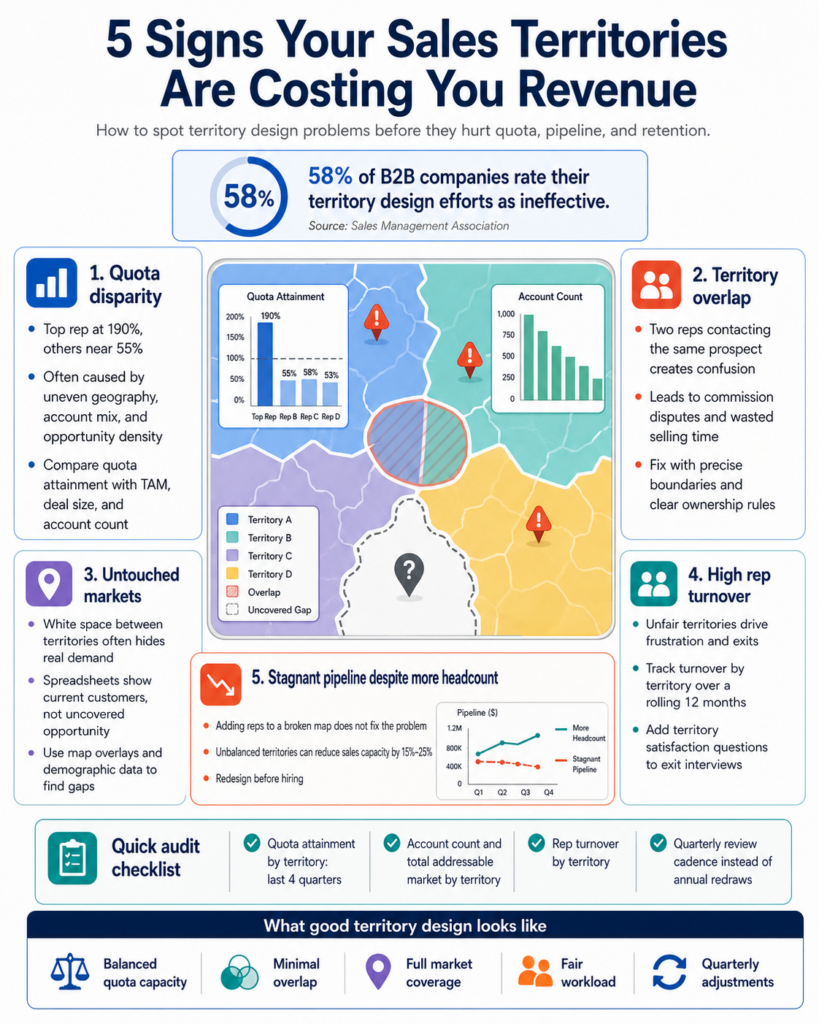
What Quota Disparity Reveals About Territory Imbalance
When Top Performers and Underperformers Are Products of Geography
A 140-point spread between your highest-performing rep and your lowest-performing rep does not always mean you have a talent gap. If the rep hitting 200% sits on a dense metro territory loaded with enterprise accounts while the rep at 60% works a rural stretch with fewer prospects per square mile, you have a territory design problem wearing the mask of a performance problem.
Research from the Alexander Group confirms this pattern: managers frequently misattribute poor results to individual reps when the root cause is territory construction. The data is worth examining before making personnel decisions. Pull quota attainment by territory, overlay it with total addressable market by geography, and the picture tends to change.
How to Separate Talent Issues from Structural Ones
Run a simple test. Rank your reps by attainment, then rank their territories by opportunity density, average deal size, and account count. If those two rankings correlate tightly, the structure is driving the outcome more than individual skill. Territory-level data in Maptive’s heat mapping tools can surface these density patterns quickly by showing where deals close versus where they stall, broken out by rep, product line, or deal size.
Fair does not mean identical. Territories with different characteristics can still produce balanced quota capacity if the targets account for those differences. A rural territory with fewer but larger accounts can carry the same revenue potential as an urban territory with high account density and smaller average deal sizes. The problem is when territory construction ignores the data entirely, and quotas get set as flat numbers regardless of what each zone contains.
One way to pressure-test this: calculate revenue per account across each territory. If one rep is sitting on accounts averaging $120,000 in annual contract value while another rep’s accounts average $38,000, the quota gap will follow. That kind of structural mismatch will not fix itself through coaching or enablement programs.
Revenue Leak from Territory Overlap and Boundary Confusion
The Real Cost of Two Reps Calling the Same Prospect
Territory overlap is more than an internal annoyance. When two reps contact the same prospect within the same week, the buyer sees disorganization. Trust drops before the first real conversation happens. Commission disputes follow, and the rep who loses the credit dispute carries that resentment into the next quarter.
Overlap tends to cluster around boundary edges, especially when territories are drawn using broad geographic markers like state lines or area codes that split metro areas in half. A prospect in a suburban office park might sit on the wrong side of a ZIP code boundary, triggering competing outreach from two reps who both believe they own the account.
How Parent-Subsidiary Account Conflicts Create Pipeline Confusion
Enterprise selling adds another layer. When a company’s headquarters sits in one territory and its regional offices sit in three others, account ownership gets murky fast. Without explicit rules for parent-subsidiary relationships, reps either fight over the same deal or assume someone else is handling it. Both outcomes cost revenue.
The fix requires boundary precision that generic geographic splits cannot provide. Drawing territories at the ZIP code, census tract, or custom polygon level, and then layering in account hierarchy rules, eliminates the ambiguity. Maptive’s territory drawing tool lets you create boundaries at that granularity while maintaining a visual map that the entire team can reference.
Role-based access controls add another layer of governance. Reps see only their own territories while managers get the full view. When account ownership questions arise, the map provides a single source of truth that prevents the back-and-forth arguments that waste pipeline momentum.
Untouched Markets Hiding in Plain Sight
Why Geographic Gaps Go Unnoticed in Spreadsheet-Based Planning
Territories built in spreadsheets tend to account for where current customers are, not where potential customers could be. The result is a map with coverage concentrated around existing accounts and white space that no one owns or monitors. Those gaps represent real revenue potential sitting unclaimed.
A territory plan that allocates by ZIP code list in a spreadsheet will not show you the 40-mile stretch between two rep zones where 2,000 businesses match your ideal customer profile. You need a visual representation of coverage layered against market data to see what is missing.
| Territory Problem | How It Shows Up | Revenue Impact |
|---|---|---|
| Quota disparity across reps | Top rep at 190%, bottom rep at 55% | High-potential zones underworked, low-potential zones over-resourced |
| Boundary overlap | Two reps contact the same prospect | Lost deals from buyer confusion, commission disputes, wasted selling time |
| Coverage gaps | No rep assigned to a region with high prospect density | Zero pipeline from addressable market worth potentially millions |
| Workload imbalance | Some reps manage 300 accounts, others manage 80 | Burnout in overloaded territories, idle capacity in underloaded ones |
| Static territory design | Same map used for 2+ years without adjustment | Misalignment with market movement, new competitors, and demographic changes |
Using Demographic Overlays to Find the Gaps
Census data and consumer spending layers reveal where demand exists independently of your current customer footprint. A territory plan informed by population density, household income, industry concentration, and business counts will identify gaps that historical sales data alone cannot.
Maptive includes over 100,000 demographic data layers at ZIP and census tract levels. Overlaying these against your current territory boundaries turns a coverage review into a revenue opportunity audit. Gaps that were invisible in a spreadsheet become obvious on a map.
High Rep Turnover Linked to Territory Frustration
The Connection Between Territory Fairness and Retention
Rep turnover is expensive. Recruiting, onboarding, and ramping a new rep costs between 6 and 9 months of lost productivity, plus the direct hiring costs. When territory frustration drives that turnover, the expense is entirely avoidable.
Territory imbalance is one of the most common complaints from sales reps, according to multiple industry surveys. Reps who believe their territory gives them a fair shot at quota tend to stay. Reps who believe the deck is stacked against them start interviewing. The perception of fairness matters almost as much as the reality of it.
What Exit Interview Data Tells You About Territory Problems
Most exit interviews ask about management, compensation, and culture. Few ask specifically about territory satisfaction. Adding that question produces data that connects turnover patterns to structural issues. If departing reps consistently cite territory size, account quality, or workload imbalance, the answer is not another round of hiring. The answer is a territory redesign.
Track which territories have the highest turnover rates over a rolling 12-month period. If the same territories keep losing reps regardless of who fills them, the territory itself is the variable, not the person.
The financial math is simple. If a rep costs $150,000 fully loaded and ramp time is 6 months, every preventable departure burns roughly $75,000 in unproductive salary before the replacement begins contributing. Multiply that across 3 or 4 territory-driven departures per year and the number becomes a line item that rivals a software budget. Fixing the territory structure is cheaper than perpetual rehiring.
Stagnant Pipeline Growth Despite Increased Headcount
Why Adding Reps Without Redesigning Territories Fails
The instinct to add headcount when pipeline stalls is common and often wrong. If existing territories are poorly constructed, adding a new rep without restructuring the map simply adds another person to a broken system. The new rep either gets carved a small zone from an already underperforming territory, or they get assigned the leftover geography that no one wanted.
Research suggests that unbalanced territories reduce total sales capacity by 15% to 25%. Adding a rep to recover that lost capacity without fixing the underlying structure is like adding a lane to a highway that has no on-ramps. The capacity exists on paper but no one can access it.
Redesigning Before Scaling
Before approving the next headcount request, audit the current territory structure. Map every active account and every prospect against rep assignments. Identify where workload concentration is highest and where it is lowest. Then determine if the stalled pipeline is a coverage problem, solvable by redistribution, or a true capacity problem, solvable by adding reps into a well-designed structure.
This distinction matters for budget conversations. A redistribution costs nothing beyond the planning time. A new hire costs $150,000 or more in the first year. If the pipeline stall can be resolved by moving territory boundaries and reassigning accounts, the headcount request should be deferred until the redesign proves it cannot close the gap alone.
This audit requires seeing the full picture on a single map rather than assembling it from disconnected spreadsheets and CRM reports. Maptive’s ability to plot up to 30,000 locations per map and overlay territory boundaries, heat maps, and demographic data on one view makes that audit practical rather than theoretical.
How to Audit Your Territory Design for Revenue Leaks
A Straightforward Review Process
Start with three data pulls: quota attainment by territory for the last 4 quarters, account count and total addressable market by territory, and rep turnover by territory. Plot these on a map rather than reviewing them in a table. Patterns that survive in tabular data for months become immediately visible when rendered geographically.
Look for clusters of underperformance that align with geographic features: territories that span too large an area, boundaries that split natural market areas, or zones where prospect density drops below a viable threshold.
Frequency of Review
Treating territory design as an annual exercise is outdated. Market conditions, rep turnover, product launches, and competitive entry all change the math mid-year. Best-in-class sales organizations review territory alignment quarterly, making incremental adjustments rather than waiting for a full annual overhaul that disrupts the entire team.
A quarterly cadence does not require rebuilding the map from scratch. It means pulling the same three data sets, refreshing the territory overlay, and asking if the indicators above have worsened or improved since the last review. Small corrections made in February prevent the kind of full-scale redesign that disrupts pipelines and commission plans in Q4.
What a Revenue-Optimized Territory Structure Looks Like
The goal is a territory map where every rep has a realistic path to quota based on the accounts, prospect density, and market potential within their zone. No rep should be structurally advantaged or disadvantaged by where their boundary lines fall. Account counts may differ between territories, but weighted opportunity value should be comparable.
When that balance exists, quota attainment distributions tighten. Fewer reps at the extremes, more clustering around target. Turnover drops because reps trust the structure. Pipeline grows because coverage gaps close. The revenue you are leaving on the table today is recoverable, but only if you identify which of these 5 signs are present in your current design and address them with data rather than intuition.