




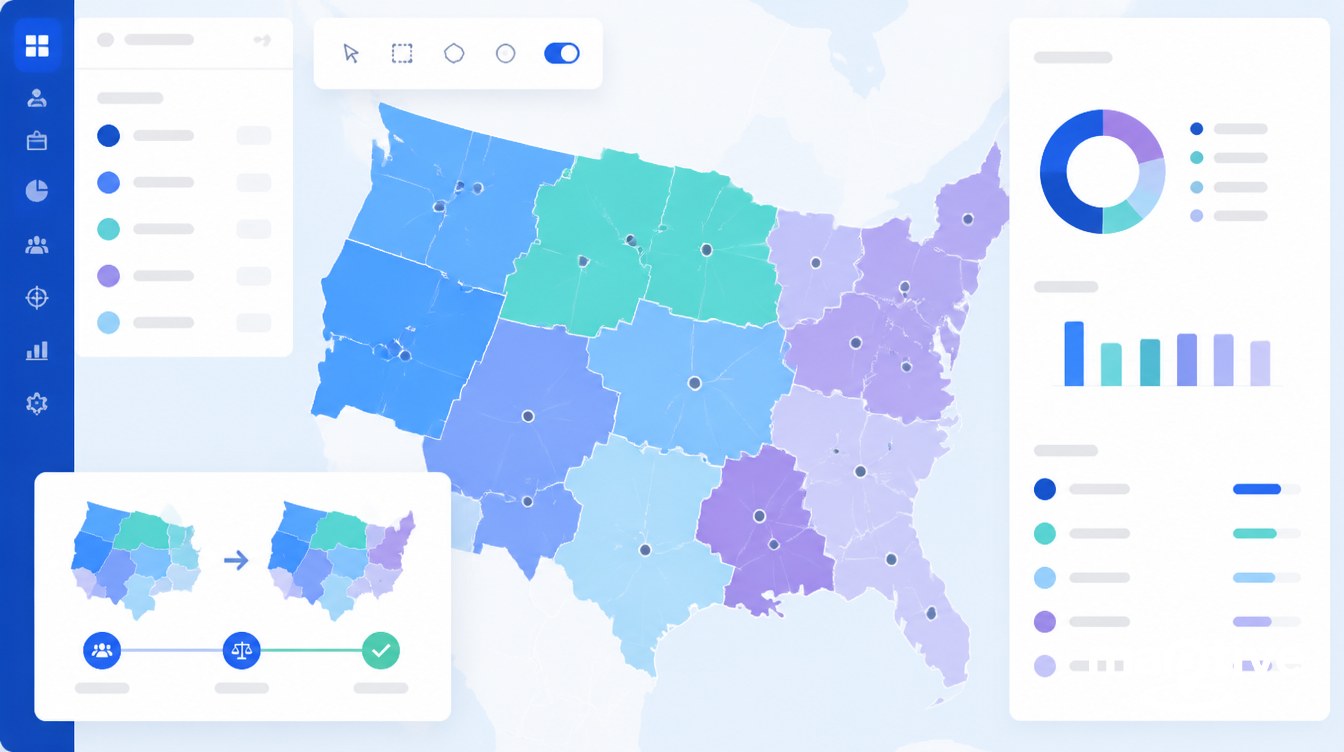

A regional VP shares the new coverage map at the Tuesday team call. Twenty minutes of slides. Eight reps on the call. The map shows that two of them have lost their top customer to a teammate. The call ends on schedule. Within forty minutes, three of the reps have a text thread going that the VP is not on. The first message is a question about commission credit on a deal in proposal. The second is a forwarded LinkedIn job posting. The third is the customer asking what is happening.
Rebalancing succeeds or fails inside the 72 hours that follow the map being shared, not inside the months of analysis that produced it. The spreadsheet was the easy part. The conversation about who keeps which account, who loses quota credit on a deal they sourced, and who tells the customer is where the work actually happens, and most leadership teams arrive at the announcement having underweighted all three.
Why Territory Rebalancing Fails in Execution, Not Design
Most published guidance on territory design treats the problem as an optimization exercise. Inputs go in, balanced patches come out, revenue per rep climbs. The 2018 Sales Management Association and Xactly research, still the most cited benchmark in 2026, found 64% of organizations report their territory design efforts as ineffective or only somewhat effective. The implication a reader is meant to draw is that better data and better tooling will fix the 64%.
The fieldwork suggests something different. Companies with effective design and companies with ineffective design draw their maps using the same inputs and largely the same software. The 30% gap in quota attainment between the two groups correlates more tightly with what happens after the map is finished than with how the map was drawn. The Alexander Group puts constrained growth at 20-30% of territories in organizations that fail to adjust periodically, but the same firms can run that figure back down with a single competent rollout cycle, no redesign required.
A Journal of Marketing study using Fortune 500 data documented 13.2% to 17.6% annual sales losses on accounts when a sales rep transition was not actively managed. In one year studied, the loss translated to more than $10 million at a single company. That is the price of a transition handled badly. The number is not paid in goodwill. It is paid in invoices that never get issued, on accounts that were already in the book.
The conclusion to take from the data is direct. The math at the center of a rebalance is the prerequisite, not the project. The project is what happens between the announcement and the next quota close, and most leaders treat that interval as a downstream concern rather than the central one.
The Math Side, Settled Before Any Conversation Happens

The numerical work has to be done first and done well, because every subsequent conversation depends on its defensibility. A manager who cannot show a rep the data inputs behind a 30% book reduction will lose the conversation, and a rep who loses confidence in the data will not trust any commitment about comp protection that follows from it.
The objectivity anchor most rebalances use is the coefficient of variation across territories. Below 15% indicates a healthy split. Between 15% and 25% indicates a rebalance is warranted. Above 25% indicates a full redesign. The figure gives leadership a defensible answer to the question every rep asks first, which is the question of necessity. Without a number to point to, the rebalance looks like preference, and reps respond accordingly.
Every account move has to be defensible on four inputs. Account potential, rep capacity, geographic load, and named-account history. A reassignment that ignores any one of the four will create a fairness gap that a competent rep will surface within a week. The history input matters most because it is the only one that captures relationship continuity, and it is the one most often left out of the model.
A legal constraint also lives in this stage. Retroactive changes to compensation terms are prohibited. A company cannot tell a rep in March that the territory or commission rate is changed effective the prior January. Every line on the new comp plan has to be written, dated forward, and signed before the announcement. The work belongs to legal and finance, not to sales operations alone, and the timing is the source of most of the headaches that follow if it is rushed.
The Announcement Sequence That Determines Rep Trust in the Process
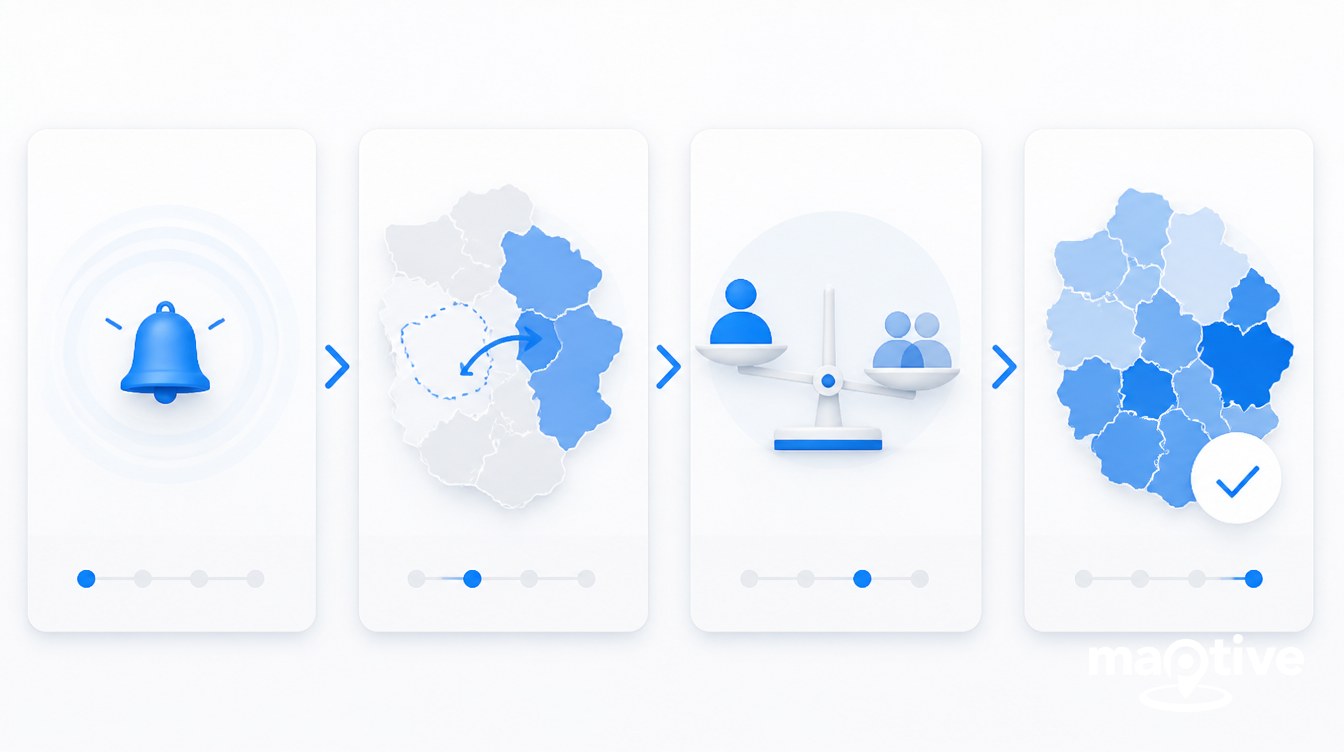
The order of the rollout decides if reps read the change as something done to them or something they have a stake in. The same map can produce two different outcomes depending on the sequence of who learns what, when. Sequencing is the entire job.
Manager Briefing Before Rep Briefing
Front-line managers see the map, the rationale, and the comp protection mechanisms one full week before any rep does. They are expected to be able to defend the design on demand, including to the rep whose top account has moved. If a manager learns the new structure on the same call as the team, the rep loses a translator and the company loses a defender. The week of advance manager briefing is also the window for managers to flag account-level errors that the central design missed.
Group Meeting With the Rationale, Not the Spreadsheet
The reveal happens in a live meeting, not a Friday-afternoon email. The agenda covers the why before the what, names the data inputs, presents the territory map, and shows the comp protection mechanisms in the same session. Reps who do not see the protections during the announcement meeting assume there are none, and that assumption hardens within hours. The Q&A is the meeting. Skipping it to stay on time signals that questions are not invited, which is the opposite of the message a rebalance needs to send.
One-on-Ones Within 48 Hours
Each rep gets a 30-minute meeting with their manager inside two business days. The meeting covers the specific deals in proposal, the named accounts moving in or out, and what their quota number is going to look like next period. Forty-eight hours is the operative limit because the rumor mill saturates faster than that. By day three, the rep has already had three conversations about the change with peers, and any answer the manager provides at that point is competing with whatever the peer group already settled on.
Customer Notification Before Any Field Activity Changes
Outgoing reps tell their customers personally, paired with the incoming rep where geography allows. The handoff transfers the relationship endorsement. A new rep operates at roughly 70-75% of veteran effectiveness during the first quarter even with strong product knowledge, and the borrowed credibility of the outgoing rep is what bridges the gap. Customers who learn about a rep change from anyone other than the outgoing rep read the change as instability, and instability is the trigger that puts a renewal up for review.
Compensation Protection Mechanisms That Prevent the Worst Behavior

Comp protection is the lever that prevents reps from gaming the announcement window or walking out in the first two weeks. Specific written rules remove the ambiguity that creates bad behavior. Reps do not game systems that publish the rules in writing. They game systems with vague rules, and the vague ones are the rules leadership tells itself it will sort out later.
In-Flight Deal Credit Rules
Deals already at proposal stage retain full credit for the originating rep for a defined window after cutover. The standard pattern most B2B sales organizations use is 100% credit in month one, 75% in month two, 50% in month three, then zero unless a split is negotiated with management. The rule has to be written and dated before the announcement, not negotiated after. Reps who do not know the rule will rush deals, sandbag activity, or move pipeline to a peer in the announcement window, and every one of those behaviors creates a fairness problem that the next quarter inherits.
Non-Recoverable Draws During Ramp
Reps inheriting unfamiliar territories get a non-recoverable draw at 100% of target variable pay for the first 90 days, stepping down to 75% in month four. The mechanism removes the income cliff that drives mid-performer flight. The DePaul University Center for Sales Leadership puts the total cost of replacing a B2B sales rep at $114,957, broken down as $29,159 to hire, $36,290 to train, and $49,508 in lost productivity, with a 6.2-month average ramp to full effectiveness. A 90-day draw priced against that figure is the cheaper option in every scenario.
Quota Adjustments Move With Coverage
If a rep loses 30% of their book, their quota moves with the book. Leaving the quota in place while the coverage shrinks is the single failure mode that erodes trust faster than any other in this category. Reps describe the change as a confiscation, and a confiscation framing does not get repaired by next quarter’s coaching cadence. QuotaPath survey data shows 75% of reps already report they do not trust their company to pay them fairly. A coverage-versus-quota mismatch confirms the prior belief, and the rep who leaves over it is gone before the next plan refresh.
Named-Account Hand-Back Windows
Reps who sourced an account retain credit on closing business for a defined window after the account moves out of their territory. The standard window is the rest of the current quota period. The rule has to be written because, in its absence, reps assume the company will keep the commission, and the assumption alone is enough to cause an exit. The same QuotaPath research found 9% of reps eventually quit specifically over commission errors or disputes, and named-account ambiguity is the most common precipitating event.
What to Expect in the First Six Months After the Rollout

A well-executed rebalance still produces measurable disruption, and leadership should plan for the disruption rather than pretending it can be designed out. The first six months will show three patterns, and the planning needs to account for all three.
The productivity dip during the new-rep ramp is the first pattern. New reps on an inherited account operate at 70-75% of veteran effectiveness for at least a quarter, sometimes two. The dip is structural and shows up in pipeline coverage, close rate, and forecast accuracy. Compressing the ramp through training is possible but bounded. Pretending the ramp does not exist is the mistake that surprises forecasters in month two.
Specific reps are most likely to leave, and the pattern is predictable. Top performers in territories that shrunk are the highest flight risk. They read the change as confiscation of earned ground and the resume goes out within ten days. Mid-performers handed bigger or less familiar territories are the second flight risk. They read the change as quota inflation without ramp support, and the QuotaPath finding that 9% of reps quit over commission disputes alone runs higher in this cohort. Plan for both. The reps who stay are usually the steady performers who were neither favored nor disadvantaged by the previous map.
The customer-side reality is a P&L question, not a service question. Acquiring a new customer costs 5 to 7 times as much as retaining an existing one, and a 5% retention improvement protects 25-95% of the relevant profit pool. A handoff that fumbles two accounts in a top-ten book can pay for itself in the wrong direction inside one renewal cycle. The handoff is the cheapest piece of customer retention work the company will do that year if it is done correctly. It is the most expensive if it is not.
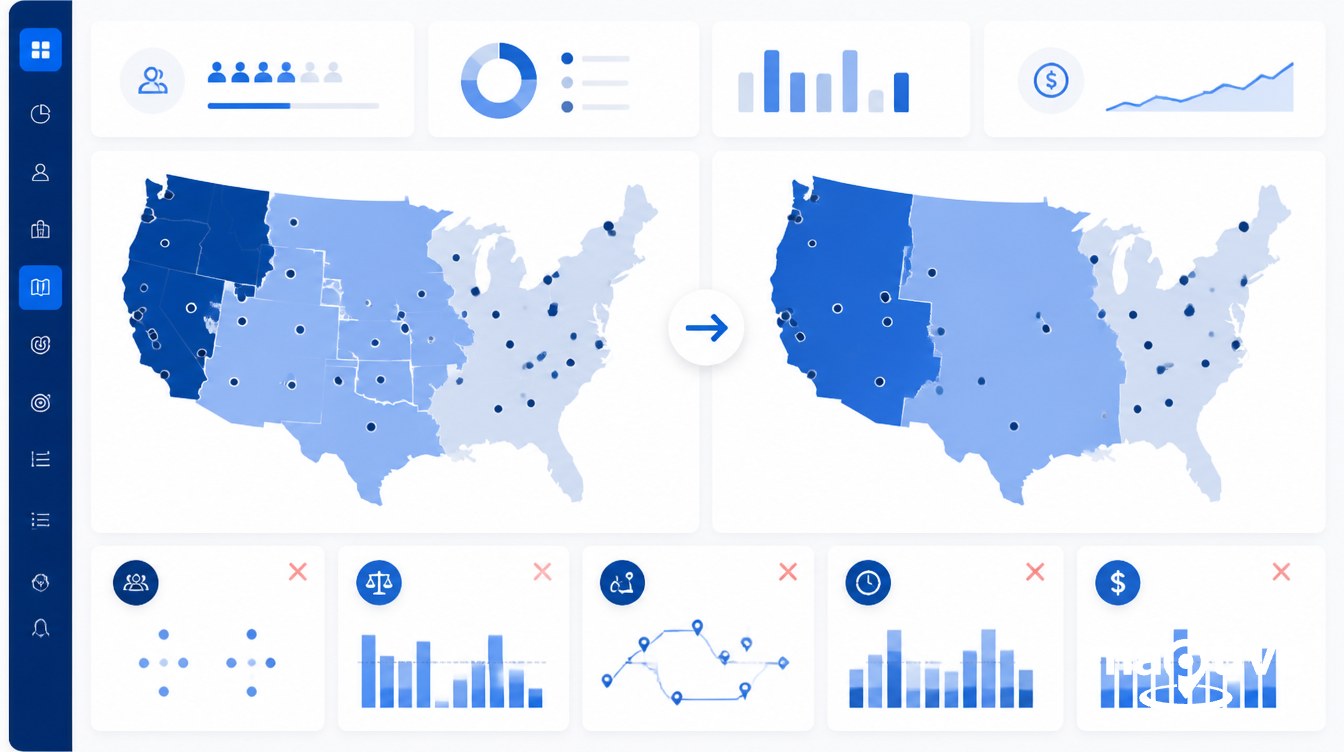
Running the new boundaries against actual customer geography before lock-in is the work that catches errors the central model misses. Mapping software like Maptive lets a regional manager pull every existing account onto the proposed map and see which assignments cut across an existing relationship, which assignments cluster two reps on the same metro, and which assignments leave a city without a senior account owner. The visual review takes a few hours. Catching one misassigned strategic account in that pass is worth more than the entire analytics pipeline that produced the map.
The leaders who finish a rebalance with their best people in place are the ones who treated the post-announcement quarter as the project. The map was the prerequisite. The conversation, the comp protection, and the customer handoff are the deliverable. The companies that get the order wrong pay the difference in turnover, lost accounts, and a quarter of forecast volatility that nobody planned for. The companies that get the order right see the 30% per-rep revenue lift that frequent, well-executed adjustments produce, and they see it because the reps and the customers both stayed.
Frequently Asked Questions

How do you rebalance sales territories without losing reps?
Communicate the rationale before the changes, involve front-line managers in the design at least a week before reps see anything, give 2-4 weeks of notice on the cutover, and publish a written in-flight commission policy before the announcement. Top performers leave when changes feel arbitrary or punitive, so the operative fix is process transparency, not larger payouts. Named-account credit continuity matters as much as the new map itself.
How often should sales territories be redesigned?
Best-in-class organizations review territory structure annually and monitor coverage continuously. A full redesign is triggered when the coefficient of variation across territories climbs above 25%. Between 15% and 25% rebalancing is warranted. Below 15% the split is healthy. Companies that adjust on an ongoing basis generate up to 30% more revenue per rep than those that wait for an annual cycle.
What percentage of sales territory redesigns underperform projections?
A 2018 Sales Management Association and Xactly study found 64% of organizations describe their territory design efforts as ineffective or only somewhat effective. Only 36% considered their territory design effective. There is nearly a 30% gap in sales-objective achievement between the two groups, with most of the gap attributable to execution rather than design.
What does it cost to replace a sales rep?
The DePaul University Center for Sales Leadership puts the total replacement cost at $114,957 per rep, broken down as $29,159 to hire, $36,290 to train, and $49,508 in lost productivity. The average ramp time to full B2B sales productivity is 6.2 months, with industry variation from 5.8 to 7.8 months. Top-performer replacement runs $500,000 to $1,000,000 depending on role and tenure.
How much revenue do you lose when a sales rep is replaced?
A Journal of Marketing study using Fortune 500 data found sales rep transitions produce 13.2% to 17.6% losses in annual sales on affected accounts. In one year studied, the loss translated to over $10 million in lost revenue at a single company. A replacement with similar industry and customer background outperforms a higher-rated rep from a different customer base.
How do you communicate a territory change to sales reps?
Share information as early as possible to prevent rumor saturation, give at least 2-4 weeks of notice on the cutover, and hold a live team meeting rather than sending a spreadsheet email. The meeting covers the data behind the decision, the new coverage map, and the comp protection mechanisms in one session. Follow with one-on-one manager meetings inside 48 hours to address rep-specific deals and quota questions.
Can you legally change a sales rep’s territory mid-year?
Yes, on a prospective basis. An organization can modify commission plans and territories mid-year if the revised targets, rates, and terms are achievable and communicated transparently. Retroactive changes are prohibited. A company cannot tell a rep in March that the territory or commission rate was changed effective the prior January.
How do you protect commission during a territory change?
Standard mechanisms include a non-recoverable draw at 100% of target variable pay for the first 90 days, dropping to 75% in month four. A second pattern protects in-flight deals on a sliding scale, with 100% credit in month one, 75% in month two, 50% in month three, and zero thereafter unless a split is negotiated. Named-account hand-back rules give the originating rep credit on close-out business for the rest of the quota period.
How do you handle account handoffs when reassigning territories?
Document the account history in CRM before the handoff, make the introduction in person from the outgoing rep alongside the new rep, give customers advance notice, and keep the outgoing rep accessible for 2-4 weeks for context questions. The formal handoff completes within five business days of the assignment cutover so customers do not perceive a service gap.
Who should tell the customer about a sales rep change?
The outgoing rep, in person, alongside the incoming rep where geography allows. The face-to-face handoff transfers the relationship endorsement, which is what bridges the productivity gap during the new rep’s ramp. A new rep operates at roughly 70-75% of veteran effectiveness during the first quarter, and the borrowed credibility from the outgoing rep covers the gap.
Why do top sales reps leave during territory changes?
The most common drivers are a shrunk territory paired with an unchanged quota, loss of named accounts they personally developed without compensation continuity, perceived unfairness in how new boundaries were drawn, and a loss of trust in management intent. QuotaPath survey data shows 75% of reps already report they do not trust their company to pay them fairly. Territory changes amplify the prior distrust unless the protections are visible and written.
How long should a territory transition period last?
For in-flight commission, 30 to 90 days is standard, often on a sliding scale. For customer relationship handoff, 2-4 weeks of overlap is typical, with the outgoing rep accessible for the duration. The formal cutover for new pipeline is a single defined date, communicated in writing before the rollout.