




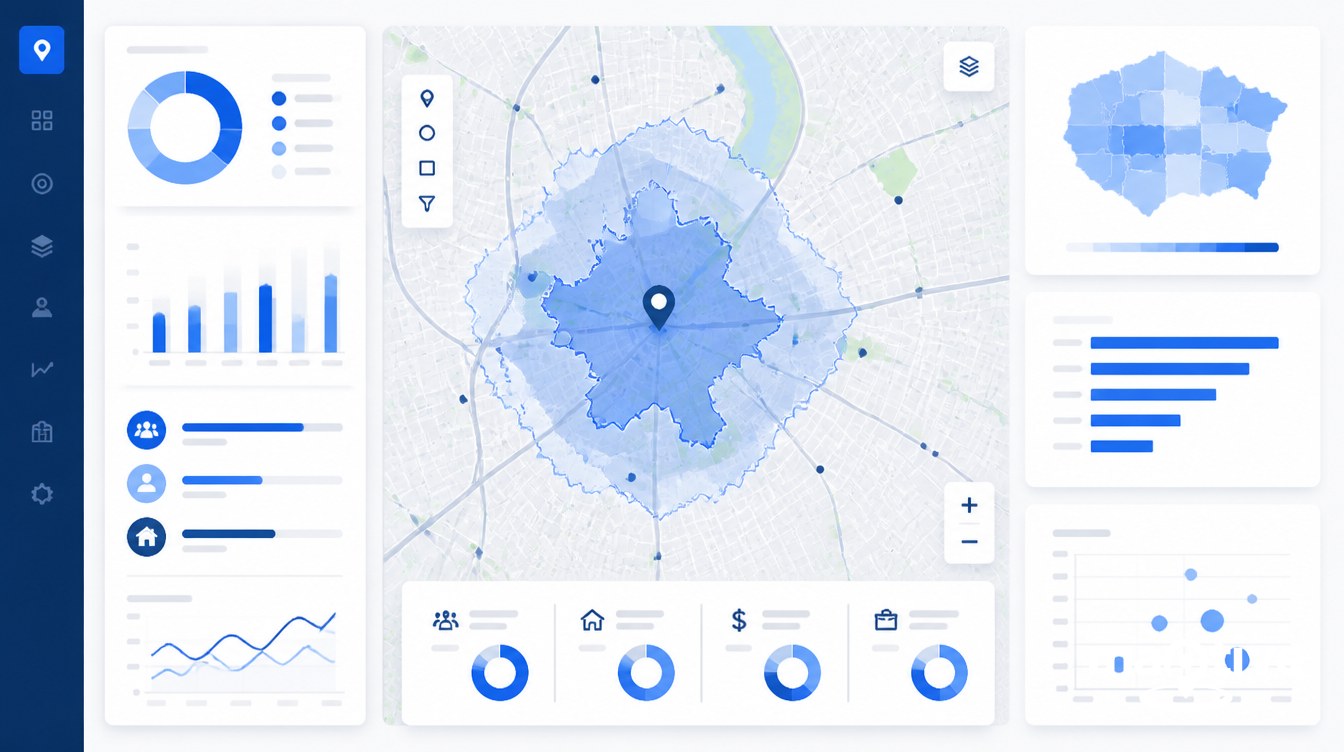
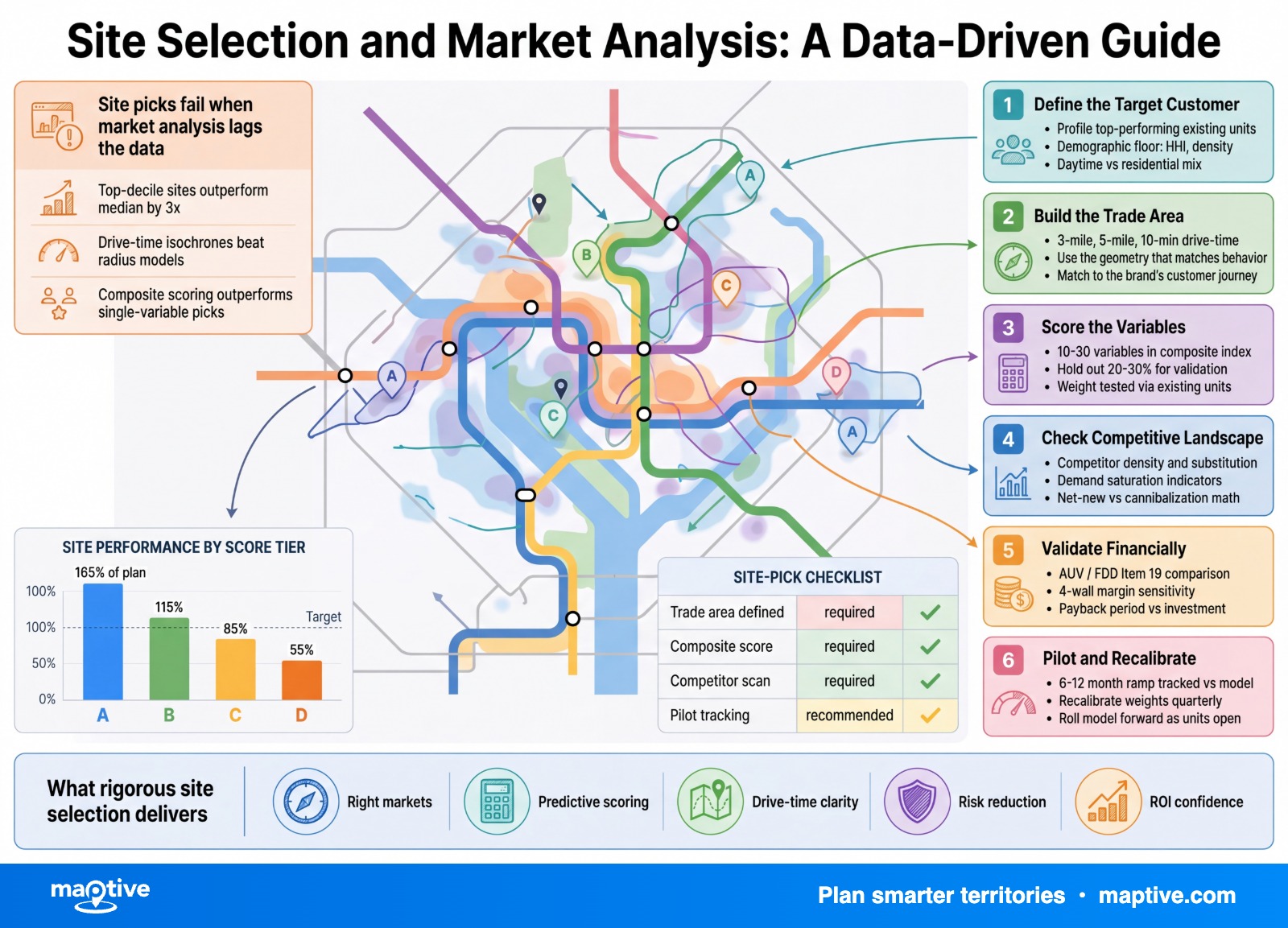
Site selection is the systematic process of identifying, evaluating, and choosing the optimal physical location for a new or expanding facility, and market analysis is the wider research process that supplies the demand, demographic, and competitive evidence the site decision rests on. The two functions overlap, but they answer different questions. Market analysis asks if a geography can support a business at all. Site selection asks which specific address inside that geography to lease, build on, or buy.
The cost of getting this wrong is concentrated in a few verticals. Roughly 17% of U.S. restaurants close in their first year and only 51.4% survive five years, with location quality consistently cited among the top causes of failure. The National Restaurant Association reported more than 72,000 U.S. restaurant closures in 2024 alone. A poorly chosen retail location traps 5 to 10 years of capital in leases, build-outs, staffing, and marketing before the operator can exit.
The location-intelligence market has scaled in response. It was valued at $21.21 billion in 2024 and is projected to grow at a 16.8% compound annual rate through 2030.
Trade Area Analysis Methods
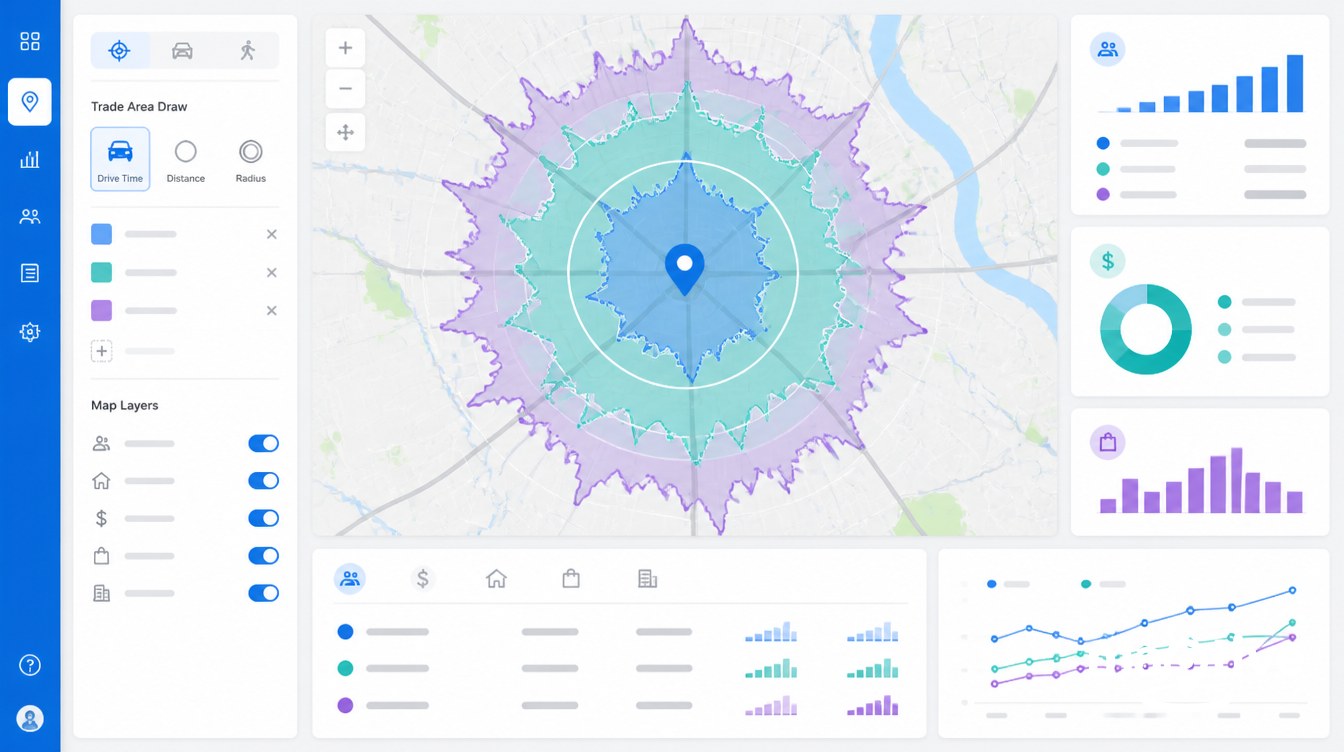
A trade area is the geographic polygon from which the majority of a location’s customers or revenue originate. Modern practice splits trade areas into three concentric tiers. The primary trade area generates 55% to 70% of customers, the secondary trade area generates 15% to 20%, and the tertiary or fringe area generates the rest.
Ring Studies
A ring study draws concentric circles around a candidate site, typically at 1, 3, and 5 miles. Rings remain the most widely used preliminary method because the shape is easy to communicate, pulls cleanly from census geography, and computes in seconds. Rings fail when geography and road networks distort actual travel. A 3-mile ring drawn across a river with no bridge overstates the served population.
Drive-Time Isochrones
A drive-time isochrone is the polygon showing how far a vehicle can travel from a candidate site in a fixed number of minutes, typically 5, 10, or 15. Isochrones honor the road network, posted speeds, turn restrictions, and average traffic conditions. The 10-minute drive-time threshold dominates everyday-retail analysis. Survey work found that 93% of consumers typically travel no more than 20 minutes for everyday purchases.
Customer-Derived Polygons
Customer-derived trade areas are drawn from data on where customers actually come from. Loyalty card billing zip codes, transaction-level geocoded addresses, and mobile-device location pings from providers such as Placer.ai or SafeGraph all produce the same kind of output. The output is a polygon traced around the real origin points of the visit stream. Placer.ai serves more than 4,000 customers as of 2025. Customer-derived polygons are the gold standard because they describe actual behavior rather than assumed behavior.
Huff Gravity Model
The Huff gravity model, formalized by David Huff in the 1960s, predicts the probability that a consumer at any location patronizes a given store. The formula expresses that probability as the store’s attractiveness, usually proxied by selling square footage or assortment depth, divided by travel cost. Calibrated Huff models published since 2020 use mobile-device visit data to fit the distance-decay exponent directly rather than relying on the textbook value of 2.
Demographic and Psychographic Inputs

Demographic data describes who lives in a trade area, psychographic data describes their lifestyles and values, and behavioral data describes what they buy. Every commercial demographic product available in the U.S. is built on the same public base layer and then enriched with surveys and proprietary modeling.
American Community Survey
The 2020-2024 American Community Survey 5-year estimates, released by the Census Bureau in December 2025, provide demographic, social, economic, and housing variables down to the census-tract level. The ACS covers more than 40 topic areas including education, employment, income, housing, language, transportation, and insurance coverage. It is free, public, and updated on a predictable schedule.
Segmentation Systems
Three major U.S. household segmentation systems sit on top of the ACS. The first classifies every U.S. residential block group into one of 67 unique consumer segments based on demographic, socioeconomic, and lifestyle characteristics. Claritas PRIZM Premier organizes U.S. households into 68 demographically and behaviorally distinct segments. Experian Mosaic USA is the third system, frequently used by CPG and direct-marketing teams.
Daytime Versus Nighttime Population
Daytime population captures workers commuting into a trade area plus visitors, while nighttime (resident) population describes who actually lives there. The two often diverge sharply. For destination retail such as office-adjacent coffee, lunch-rush QSR, and dry cleaners, daytime population is the more relevant denominator. For grocery, hardware, urgent care, and dinner-anchored restaurants, the resident base does the work.
Index of Retail Saturation
The Index of Retail Saturation is the classic textbook measure of unmet demand. It equals households multiplied by annual retail spending per household, divided by existing retail square footage in the trade area. Higher values point to under-served demand. Lower values indicate over-saturation. For most service franchises, planners look for 25,000 to 50,000 people per unit. For food franchises, the typical density threshold is 15,000 to 25,000 people per location.
Foot Traffic, Co-Tenancy, and Visibility Factors
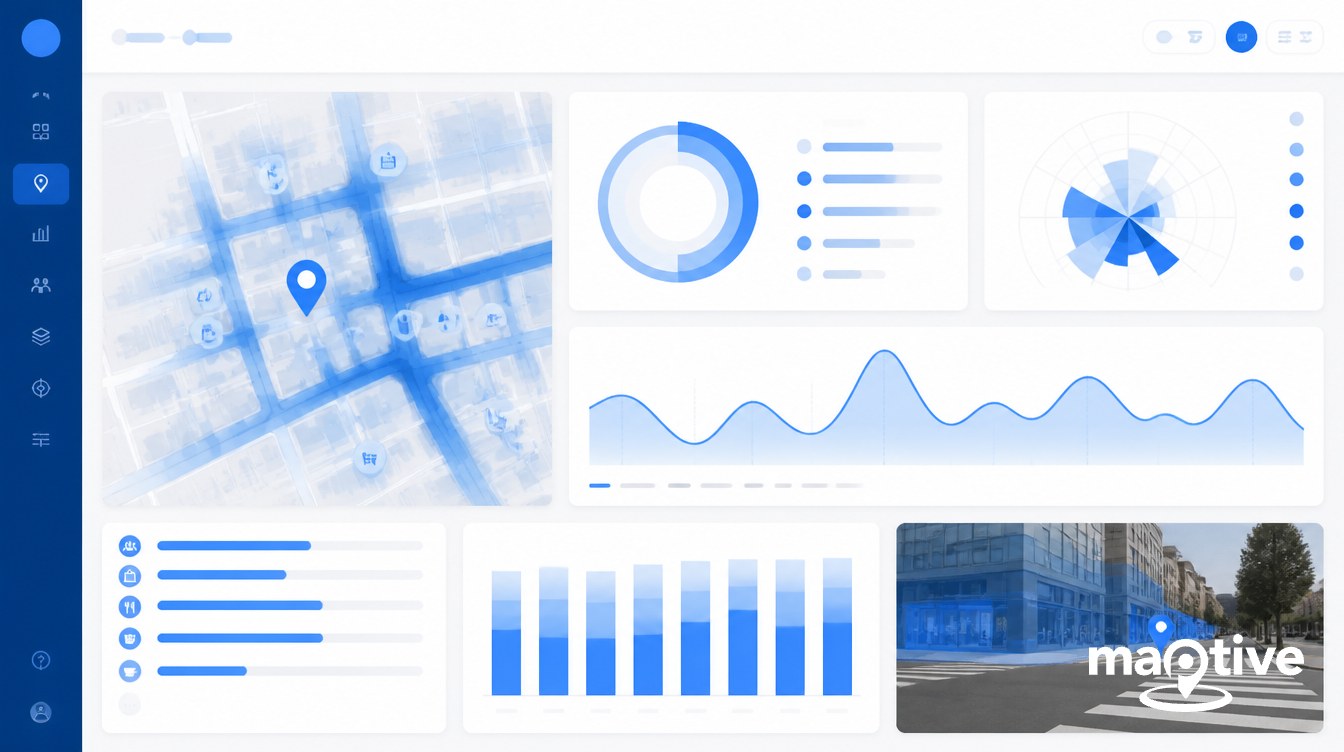
Demographic fit gives a site enough potential customers. Foot traffic, co-tenancy, and visibility determine if those potential customers actually arrive at the door.
AADT and Daypart-Matched Traffic
Annual Average Daily Traffic is the total annual vehicle volume on a road segment divided by 365 days. AADT is the standard traffic-volume statistic used in both transportation engineering and retail site selection. Different verticals target different AADT ranges. Starbucks specifies a minimum 25,000 vehicles per day. QSR site evaluations typically seek 20,000 to 40,000 vehicles per day. Convenience stores prefer the 5,000 to 15,000 range.
Anchor Tenants and Co-Tenancy Clauses
Anchor tenants drive 60% to 80% of total customer visits and sales at malls and outdoor lifestyle centers. A co-tenancy clause is a provision in a commercial lease that allows the tenant to reduce rent or terminate the lease if anchor tenants vacate or center occupancy drops below a contractual threshold. A December 2024 California Supreme Court ruling preserved the validity of standard co-tenancy remedies in California.
Visibility, Access, and Parking
Visibility from the primary roadway, signalized intersections, left-turn signals, and unobstructed sightlines from at least one direction of travel appear as required line items on most retail and QSR site checklists. Parking ratios benchmark to ICSC shopping-center standards. Community and neighborhood shopping centers run roughly 4 to 4.5 spaces per 1,000 square feet. Restaurant-heavy centers run higher, frequently 8 to 12 spaces per 1,000.
Predictive Modeling and Sales Forecasting
A modern new-store revenue forecast combines five categories of input. Trade-area demographics describe the customer pool. Analog-store performance grounds the projection in observed sales-per-square-foot from comparable stores. Foot-traffic and accessibility data describe how many customers actually reach the door. Competitive density and cannibalization risk adjust for overlap. Macro market trends supply the rate of growth or decline.
Analog matching is the most intuitive and defensible component. The analyst selects the most similar existing stores matched on trade-area demographics, store size, format, and tenancy, then projects their actual sales-per-square-foot distribution onto the proposed site.
Regression-based site models layer formal coefficients on top of the analog logic. Machine-learning models earn their place at the next level of detail. Decision trees and gradient-boosted ensembles capture nonlinearities that linear regression misses.
McKinsey research published in 2024 found that retailers using network optimization driven by spatial analytics identified revenue opportunities of up to 20% of their existing base. Generative-AI site-selection platforms reached production scale in 2025. Cavender’s Western Wear opened 9 new stores in 2024 under traditional methods, then 27 new stores in 2025 after adopting an AI-driven location-intelligence stack.
Vertical-Specific Considerations
QSR and Restaurants
Restaurant site selection turns on daypart-matched traffic rather than total volume. Cluster effects matter more than competitive avoidance for fast food. Per the National Restaurant Association’s 2025 data, median occupancy ran 5.7% of sales for full-service restaurants and 5.2% for limited-service operations in 2024.
Grocery and Convenience Stores
Grocery trade areas run 8 to 12 minutes drive time, with population density inside that envelope as the dominant demand driver. The optimal c-store sits adjacent to a road carrying 5,000 to 15,000 vehicles per day, on a corner with two traffic streams.
Healthcare
Healthcare site selection adds variables that consumer retail does not use. Urgent-care site validation incorporates demographics, psychographics, competition from other providers, medical alternatives, crime statistics, and insurance-coverage ratios. Clinician supply has become a binding constraint. Roughly 1 dentist per 2,000 to 2,500 residents inside a 1-mile radius is treated as healthy.
Fitness and Family Entertainment
Fitness operators target accessible, visible, well-parked spaces with ceiling height of at least 12 feet. Fitness and family-entertainment brands signed more than 200 new leases for spaces over 20,000 square feet between 2024 and the first half of 2025.
Banking
Bank branch site selection has its own public data infrastructure. The FDIC Summary of Deposits covers more than 76,000 domestic offices operated by more than 4,500 FDIC-insured institutions. In 2023, U.S. banks added more net new branches than they closed for the first time in a decade.
Automotive and Hospitality
Automotive dealerships work inside a Primary Market Area, or PMA, typically defined by franchisors via census tracts or zip codes. Hospitality site selection runs through a formal feasibility study. STR and Tourism Economics held their 2024-25 forecast at +2.0% RevPAR year over year.
Cost, Lease, and Real Estate Factors
Sales per square foot is the canonical retail productivity metric. Grocery and supermarket sales typically run $400 to $700 per square foot, with premium chains exceeding $1,000 and Costco roughly $1,500. QSR ranges from $500 to $1,200. Starbucks generates around $1,000 per retail square foot.
Occupancy cost as a percentage of sales is the matching denominator. Median full-service restaurant occupancy ran 5.7% of sales in 2024, with limited-service at 5.2%. Most retail categories target 6% to 12% depending on format and gross margin.
Ownership structure changes the site-selection logic. Starbucks leases roughly 90% of its locations. McDonald’s owns about 55% of the land and 80% of the buildings under its restaurants, and rent accounts for roughly 64% of franchise revenue.
The U.S. retail availability rate declined 20 basis points in 2024 to 4.6%. Zoning and entitlement risk closes the cost discussion. Conditional Use Permits allow a use that isn’t permitted by right but may be approved with operating conditions on hours, parking, or sound levels. Build the entitlement timeline and its conditions into the financial model from the start.
Performance Measurement and Whitespace Mapping
Market penetration is the share of households in a trade area that are active customers of the brand. Share of trade area is the same idea calculated against a defined polygon. The whitespace workflow inverts performance measurement and turns it into expansion strategy. Three conditions must hold simultaneously for a market to count as whitespace.
A common whitespace workflow profiles the top 20% of existing stores by performance, identifies what those trade areas have in common, then searches nationally for trade areas matching that success profile with no current brand presence.
Cannibalization analysis quantifies the redistribution risk. Cannibalization rate equals the estimated sales lost by an existing store divided by that store’s prior-period sales, multiplied by 100. A rate above 20% is generally treated as a warning. Starbucks famously tolerates internal cannibalization, opening multiple locations within sight of each other.
Common Failure Modes
The first failure is over-reliance on data without on-the-ground site visits. The second is ignoring cannibalization risk. The third is defining trade areas with simple radius rings instead of customer-derived polygons. The fourth is underestimating zoning and entitlement timing. The fifth is rushing under pressure to hit a real-estate target. The sixth is local-knowledge bias overriding data. The seventh is tunnel-vision on quantified variables such as rent and labor cost while missing workforce quality. The eighth is failing to document the site decision for post-mortem learning.
A single underperforming retail location drains capital through multi-year leases, build-out costs, staffing, and marketing spend, often for 5 to 10 years before the lease can be exited. Site-selection rigor is risk management more than it is growth strategy.
Frequently Asked Questions

What is site selection?
Site selection is the systematic process of identifying, evaluating, and choosing the optimal physical location for a new or expanding business facility based on demographic, competitive, accessibility, and financial criteria.
What is the site selection process?
A typical corporate site-selection process runs three phases. Phase 1 screens hundreds of candidate markets down to roughly 10 to 15 finalists. Phase 2 covers detailed evaluation with financial modeling and site visits. Phase 3 closes incentives and lease negotiation.
What is market analysis?
Market analysis is the process of gathering and interpreting information about an industry, target audience, competitors, and the economic forces that shape demand inside a defined geography. Site selection answers which address. Market analysis answers if a market is worth entering at all.
What is a primary trade area?
A primary trade area is the inner zone closest to a store that generates the largest share of customers, typically 55% to 70%. It usually corresponds to a 5- to 15-minute drive from the location depending on the vertical.
What is a Huff gravity model?
The Huff model is a probability-based gravity model that predicts the chance a consumer at any location patronizes a specific store. The probability equals the store’s attractiveness divided by travel cost, normalized against the same ratio for all competing stores.
What demographics are most important for site selection?
The most important site-selection demographics are population density, age distribution, household composition, household income, education, and employment, plus daytime population for office-adjacent retail. Insurance coverage matters for healthcare.
What is daytime population?
Daytime population is the number of people present in a trade area during normal business hours, including workers who commute in and visitors. It matters most for lunch-driven QSR, business-district coffee, and lunch-rush retail.
What is the failure rate of new restaurants?
Per 2024 U.S. Bureau of Labor Statistics data, 80.9% of restaurants survive their first year, 51.4% survive five years, and 34.6% survive ten years. Roughly 17% fail in year one. Location quality is consistently cited among the top causes of failure.
What is the Index of Retail Saturation?
The Index of Retail Saturation equals households multiplied by annual retail spending per household, divided by existing retail square footage inside a trade area. Higher values point to unmet demand.
How is AI used in site selection?
AI is used to forecast new-store revenue with regression, decision tree, XGBoost, and neural-network models, to predict foot traffic for candidate sites, to detect whitespace and void opportunities, and to power natural-language platforms.